



Feeling like you need a scenic mountain or exotic beach to take great photos? The most powerful subjects for a beginner photographer in India are often right outside your window, offering lessons in light, composition, and timing. Let's start shooting.
Finding Art in the Everyday
For anyone starting their photography journey, it's easy to believe that compelling images require extraordinary locations. But the truth is, the most valuable skill a photographer can develop is learning to see the beauty and drama in ordinary, everyday scenes. Two of the most accessible yet challenging subjects for any Indian photographer are the magnificent monsoon sky and the chaotic, yet rhythmic, flow of city traffic. Mastering these teaches you more about the fundamentals of light, patience, and composition than any 'perfect' landscape ever could. They force you to look closer, adapt to difficult conditions, and find a unique perspective. These subjects are not just convenient; they are your best teachers, available to you almost daily.
Capturing the Drama of Monsoon Skies
The Indian monsoon brings more than just rain; it paints the sky with some of the most dramatic and emotive cloud formations imaginable. These are not just bland, grey blankets but dynamic, textured subjects full of light and shadow. To begin, stop thinking of the sky as a simple background. Make the clouds the main element of your photograph. A basic composition tip is the 'rule of thirds': place the horizon on the bottom third of your frame, allowing the clouds to dominate the upper two-thirds. Look for moments when the sun tries to break through, creating incredible beams of light, or use the dark, moody clouds as a backdrop to make colourful buildings pop. Many smartphones have an 'HDR' (High Dynamic Range) mode, which is perfect for these situations as it helps capture detail in both the bright sky and the darker ground simultaneously. Don't wait for the perfect clear day; the most interesting skies are often the most turbulent.
Techniques for Moody Cloudscapes
To give your cloud photos more impact, focus on their texture and form. Instead of trying to capture the entire sky, use your lens to frame a particularly interesting section of clouds. Silhouettes are another powerful tool. Position yourself so that a building, a temple spire, or a lone tree is framed against the dramatic sky. This creates a strong sense of place and contrast. The time of day is also crucial. The 'golden hours' around sunrise and sunset can illuminate clouds with spectacular shades of orange and pink, even during the monsoon. Similarly, the 'blue hour', the period just after sunset, can provide a deep blue canvas that makes city lights and clouds stand out. A polarising filter, an accessory available even for some phones, can also help make clouds appear more defined and 'pop' from the sky.
Turning Traffic Chaos into Art
At night, the endless streams of headlights and taillights in an Indian city can be transformed from a stressful jam into a beautiful river of light. This is achieved through a technique called 'long exposure' photography, and it is more accessible than you think. You don't necessarily need a high-end DSLR. Many modern smartphones now have a 'Pro' or 'Manual' mode that allows you to control the shutter speed. The idea is to keep the camera's shutter open for several seconds. During this time, any stationary objects like buildings will remain sharp, while moving lights—like those from cars, buses, and autorickshaws—will blur into vibrant streaks. This technique turns the visual noise of traffic into a smooth, artistic expression of energy and movement.
Simple Steps for Stunning Light Trails
To create your own traffic light trails, the first step is stability. You must keep your camera or smartphone perfectly still. A small tripod is ideal, but you can also prop your device securely on a wall, a railing, or the roof of a parked car. Find a safe vantage point, like a pedestrian overbridge or a balcony overlooking a busy road. In your camera's pro mode, set the ISO to a low value (like 100) and the shutter speed ('S') to anywhere between 5 and 30 seconds. Use the camera's self-timer (2 or 5 seconds) to avoid shaking the device when you press the shutter button. Then, watch as the passing vehicles paint lines of red and white light across your frame. The best time for this is the blue hour, when the sky still has some colour to balance the artificial lights of the city.
Beyond Light Trails: The Human Element
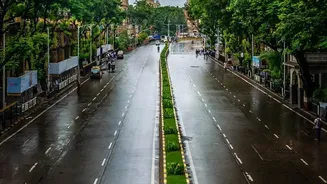
While light trails are a fantastic start, city traffic offers more stories to tell. During the day, try changing your perspective. Get low to the ground and capture the motion of wheels whizzing by, or focus on the reflections in puddles on a rain-soaked street. The people within the traffic are also compelling subjects. A candid shot of a driver, a family on a scooter, or commuters looking out of a bus window can tell a powerful story about city life. Slow down and observe. Notice how street vendors interact with the traffic, or how people navigate the bustling intersections. Photography is ultimately about telling stories, and Indian streets are filled with countless narratives waiting to be captured through your lens.