
A Surprising and Critical Discovery
For decades after the Apollo missions, the Moon was considered bone-dry. The first samples returned to Earth seemed to confirm this, lacking minerals consistent with a moist environment. This perception dramatically shifted thanks to a series of orbital
missions. A key moment came in 2008 when India's Chandrayaan-1 spacecraft, carrying a NASA instrument called the Moon Mineralogy Mapper (M3), provided the first direct and unambiguous evidence of water ice on the lunar surface. The data confirmed that ice was present, particularly concentrated at the poles in areas that never see sunlight. A year later, NASA's LCROSS mission deliberately crashed a probe into a polar crater, and the resulting plume was found to contain water, providing definitive proof. This wasn't vast sheets of ice, but rather ice mixed in with the lunar soil, or regolith.
More Than Just a Drink
The existence of lunar water is exciting not just because astronauts will need to drink it. Its true value lies in its versatility, a concept known as in-situ resource utilization (ISRU), which is the practice of living off the land. Through a process called electrolysis, an electric current can split water (H2O) into its component parts: oxygen and hydrogen. The oxygen can be used to create breathable air for habitats, a fundamental requirement for any long-term outpost. Even more critically, liquid oxygen and liquid hydrogen are the primary components of one of the most powerful and efficient rocket propellants known. Having a local source of water means the Moon could one day become a refueling station, drastically reducing the cost and complexity of space missions. Instead of launching all the necessary fuel from Earth—a costly endeavor due to our planet's strong gravity—spacecraft could top up their tanks on the Moon for journeys deeper into the solar system, such as to Mars.
The Cold, Dark Reservoirs
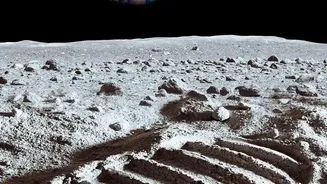
This invaluable resource is located in some of the most hostile environments in the solar system: permanently shadowed regions (PSRs) inside craters near the lunar poles. Because the Moon's axis is only slightly tilted, the floors of some deep polar craters have not been touched by direct sunlight for billions of years. Temperatures in these cold traps can plummet to as low as -233°C, colder than the surface of Pluto, allowing water ice delivered by comets and asteroids to remain frozen in time. While this extreme cold preserves the ice, it also presents immense engineering challenges. Solar-powered rovers would not function in these dark craters, and any machinery must be able to withstand the cryogenic temperatures without failing. Extracting the ice-rich regolith and heating it to release the water vapor will require significant energy and robust, specialized equipment.
The Coming Lunar Gold Rush
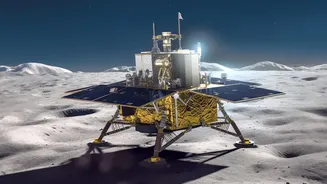
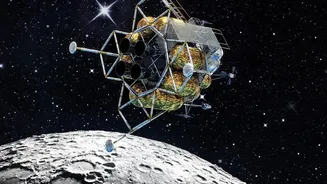
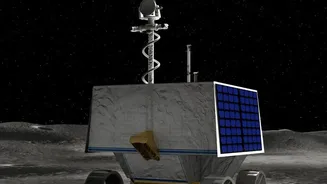
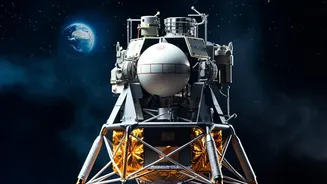
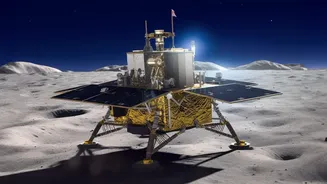
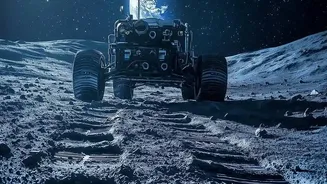
With the potential of lunar water confirmed, a new space race is underway to develop the technology to map and access it. NASA's Artemis program, which aims to establish a sustainable human presence on the Moon, is heavily reliant on this resource. A key upcoming mission is the Volatiles Investigating Polar Exploration Rover, or VIPER. This golf-cart-sized rover is designed to venture into the Moon's permanently shadowed regions, drill into the surface, and create the first resource maps of lunar water ice, identifying its concentration and accessibility. After being cancelled and then revived, the mission is now slated to land on the Moon in 2027 via a Blue Origin lander. International partners are also joining the hunt. A collaboration between JAXA (Japan Aerospace Exploration Agency) and ISRO (Indian Space Research Organisation) will fly a NASA instrument to scout for water as well. These robotic prospectors are the crucial next step, paving the way for future human missions to know exactly where to go to set up camp.