






The Brain's Hidden Gatekeeper
Imagine every cell in your brain has its own internal scaffolding, a microscopic skeleton that gives it shape and structure. For years, scientists thought this was its main job. But recent research, primarily from Penn State, has revealed it does something
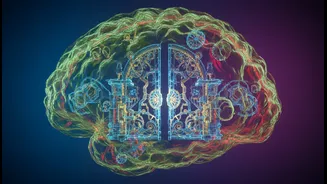
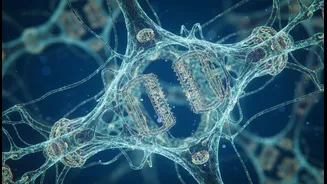
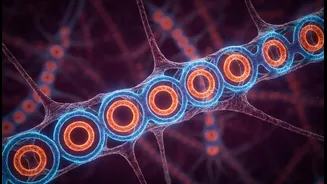
far more critical. This structure, known as the membrane-associated periodic skeleton (MPS), is a lattice made of repeating protein rings located just under the neuron's surface. It turns out this MPS is not a passive frame but an active gatekeeper, controlling the constant flow of materials into the brain cell. This process, called endocytosis, is vital for everything from absorbing nutrients to learning and memory. The MPS essentially decides what gets in, where, and when.
A Discovery with Shocking Implications
Using powerful super-resolution microscopy, researchers were able to watch this cellular skeleton in action. They discovered that the MPS acts as a physical barrier, slowing down and regulating how the neuron absorbs substances from the fluid surrounding it. The most startling finding was how this gatekeeper behaves under pressure. When the process of bringing things into the cell (endocytosis) speeds up, it can actually weaken the MPS lattice. This creates a dangerous feedback loop: increased uptake of materials triggers signals that command proteins to cut apart the skeleton, opening more entry points and allowing even more substances to flood in. It’s a system that, when working correctly, helps neurons respond quickly, but when it goes wrong, the consequences can be severe.
The Direct Link to Alzheimer's
This is where the connection to Alzheimer's disease becomes alarmingly clear. The disease is famously characterized by the buildup of toxic proteins, particularly amyloid plaques. Researchers at Penn State designed experiments to mimic the conditions of early-stage Alzheimer's. They found that when the MPS gatekeeper structure was weakened or damaged, neurons began to rapidly absorb harmful proteins associated with the disease. Specifically, a degraded MPS sped up the intake of amyloid precursor protein (APP). Once inside the neuron, this protein is cut into toxic fragments, like amyloid-beta 42, which are strongly linked to the cell death seen in Alzheimer's. In essence, a faulty gate allows the enemy to walk right through the front door. Neurons with a damaged MPS accumulated these toxic molecules and showed more signs of dying.
A New Piece in a Complex Puzzle
For decades, Alzheimer's research has focused heavily on the amyloid plaques that form outside of cells and the tau tangles that form within. This new discovery doesn't replace those theories but adds a crucial, earlier chapter to the story. It suggests that the integrity of the cell's own internal skeleton could be a key factor in determining its vulnerability. If the MPS is strong and stable, it can act as a line of defense, limiting the entry of the proteins that ultimately lead to plaques and tangles. If it is compromised—perhaps due to aging or other pathological conditions—it can accelerate the disease process. This finding provides a potential mechanical explanation for how the toxic protein buildup, a hallmark of Alzheimer's, gets out of control.
What This Means for the Future
This insight opens up an exciting new avenue for potential treatments. Instead of just trying to clear away amyloid plaques after they have already formed, researchers can now explore ways to strengthen the MPS and fortify the brain cell's natural defenses. Stabilizing this gatekeeper structure could become a promising new strategy to prevent or slow down the damage before it starts. According to Ruobo Zhou, an assistant professor at Penn State and author on the study, the discovery helps explain the molecular machinery connected to neurodegenerative diseases. While a cure is not on the immediate horizon, identifying a new target like the MPS is a significant leap forward. It provides the scientific community with a fresh perspective and a new set of tools to fight a disease that has proven incredibly difficult to understand and treat.