

A Landmark Discovery
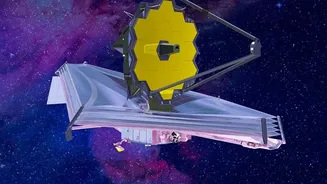
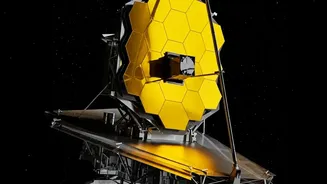
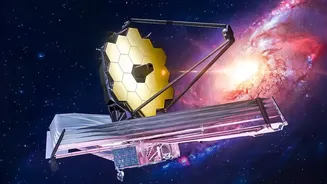
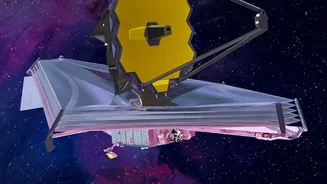
In a landmark achievement, the JWST has successfully confirmed the presence of water vapour in the atmospheres of several planets outside our solar system, known as exoplanets. One significant recent discovery confirmed with JWST data is on a planet named
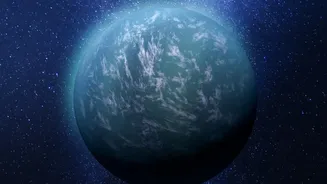
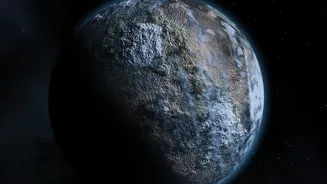
GJ 9827 d, located nearly 100 light-years away. This world, roughly twice the size of Earth, has an atmosphere rich in water, leading scientists to dub it a potential "steam world." While initial hints were found by the Hubble Space Telescope, it was Webb's superior infrared sensitivity that confirmed the planet's water-rich nature. This isn't just a trace amount; it's the first time an atmosphere so dominated by heavy molecules like water has been seen on such a small planet.
How Webb 'Sees' Water
The JWST doesn't look for water with a camera in the traditional sense. Instead, it uses a technique called transmission spectroscopy. When an exoplanet passes in front of its host star from our point of view—an event called a transit—a tiny fraction of the starlight filters through the planet's atmosphere. The gases and molecules in that atmosphere absorb specific wavelengths, or colours, of the starlight. Every molecule, including water (H2O), has a unique absorption signature, like a chemical fingerprint. By analysing the starlight spectrum before, during, and after a transit, astronomers can identify which molecules are present. Webb's incredible sensitivity allows it to detect these subtle fingerprints from light-years away, even on relatively small worlds.
A Steamy, Not Necessarily Earth-like, World
Finding water vapour is a monumental step, but it's crucial to manage expectations. GJ 9827 d, for example, is not a candidate for a vacation home. It orbits its star every 6.2 days and has a scorching surface temperature of around 430 degrees Celsius, similar to Venus. At this temperature, any water would exist as a thick, inhospitable steam. The discovery is significant not because this specific planet is habitable, but because it proves that planets with abundant water can exist and that our technology is now capable of finding them. Scientists are still debating the planet's nature: it could be a 'mini-Neptune' with a hydrogen-rich atmosphere laced with water, or a new type of 'steam world' where the atmosphere is almost entirely water vapour.
A Stepping Stone to Finding Habitable Worlds
The ultimate goal for many astronomers is to find a true Earth-twin: a rocky planet with liquid water on its surface, orbiting within its star's 'habitable zone' where temperatures are just right. The detection of water vapour on planets like GJ 9827 d and other hot giants like WASP-18 b and WASP-39b serve as crucial test cases. These observations prove the technology and refine the methods scientists will use to analyse the atmospheres of smaller, cooler, rockier planets that are much harder to study. Each detection is a step on the ladder, teaching astronomers more about planetary formation and the diversity of atmospheres in our galaxy. By cataloging what is possible, from hot Jupiters to steam worlds, scientists are building the toolkit needed to one day spot the faint signals of a potentially life-sustaining atmosphere.
What's Next for Webb?
The search is only just beginning. With its mission planned for many more years, the JWST will turn its gaze to countless other exoplanets. Scientists are eager to move beyond simply detecting water and start searching for a full inventory of atmospheric chemicals, including potential biosignatures—gases like methane and oxygen that could hint at biological processes. For instance, on a world like GJ 9827 d, Webb's instruments can search for carbon-bearing molecules like carbon monoxide and methane, which would provide clues as to how and where the planet formed. The discovery of water vapour is not the final destination in the search for alien life, but it is the lighting of a critical beacon, signalling that we finally have the right map to begin the exploration in earnest.