



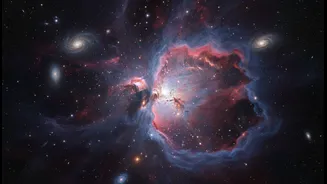


Seeing the Invisible
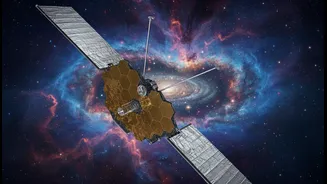
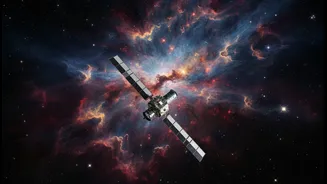
The magic behind the James Webb Space Telescope (JWST) lies in its ability to see a universe that is invisible to the human eye. While its predecessor, the Hubble Space Telescope, primarily observes in visible and ultraviolet light, Webb is optimized
for infrared. Think of it as a form of cosmic night vision. This infrared capability is a game-changer because much of the universe is shrouded in vast clouds of cosmic dust and gas. Visible light gets scattered and blocked by this dust, much like car headlights in a thick fog. Infrared light, however, has a longer wavelength that can pass through these dusty veils unimpeded. This allows Webb to peer into regions that were previously opaque, revealing the hidden processes of the cosmos. By detecting this invisible light, or heat energy, Webb is able to capture the universe in a completely new light.
Cosmic Nurseries in High Definition
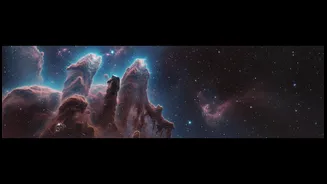
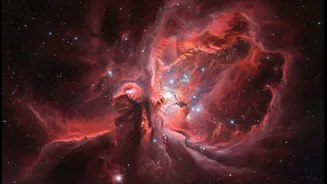
Some of Webb’s most iconic images are of stellar nurseries, the places where stars are born. Take the famous Pillars of Creation, located in the Eagle Nebula. Hubble's 1995 image showed them as dense, dark columns of gas and dust. In contrast, Webb’s near-infrared view renders these same pillars semi-transparent and flushed with detail. We can suddenly see hundreds of newly formed, bright red stars still in their cosmic cribs—stars that were completely hidden in Hubble’s view. The dust clouds that seemed like static, impenetrable walls are revealed by Webb to be dynamic, three-dimensional structures. By cutting through the dust, Webb transforms a beautiful but remote astronomical object into an active, bustling star factory, making the process of stellar birth feel immediate and real.
A Telescope is a Time Machine
Because light takes time to travel across the vastness of space, looking at distant objects is also looking back in time. Webb isn't just a telescope; it's a time machine. The universe is constantly expanding, and as light from the most ancient galaxies travels toward us, its wavelength gets stretched into the infrared spectrum—a phenomenon called redshift. Webb’s extreme sensitivity to infrared light allows it to capture this stretched-out light from some of the earliest galaxies that formed just a few hundred million years after the Big Bang. Where Hubble gave us tantalizing glimpses, Webb delivers high-definition portraits of the universe's infancy. This capability brings abstract cosmological concepts, like the formation of the first galaxies, out of the realm of pure theory and into observable science.
The Art of Scientific Translation
It's important to remember that the colours in Webb's images are not what our eyes would see, because we can't see infrared. The images are initially captured in greyscale through different filters, each corresponding to a specific infrared wavelength. Scientists and image processors then assign colours—typically red to the longest wavelengths and blue to the shortest—to translate this invisible data into a visual format that humans can interpret. This process isn't just for aesthetics; it's a crucial part of the scientific analysis, allowing astronomers to visualize the chemical composition, temperature, and density of celestial objects. It is this careful and beautiful translation of data that transforms complex information into the stunning, emotionally resonant images that captivate the public.
A Universal Human Connection
Ultimately, the power of Webb's images lies in their ability to foster a sense of connection. By revealing stellar nurseries, Webb shows us the very origins of stars, and by extension, the elements that make up our planets and even our own bodies. These images inspire a sense of awe and wonder, serving as powerful educational tools that can communicate complex scientific ideas to the public. In a 2023 survey, about a quarter of American adults reported having looked at an image from a space telescope like Webb in the past year, showing a significant public engagement. By making the cosmos more visible, detailed, and vibrant, Webb’s images don’t just make space less abstract—they make our place within it feel more profound.