


What Is a ‘Day,’ Anyway?
Before we unpack Mercury's strange schedule, we need to clarify what we mean by a ‘day’. On Earth, the time it takes to spin once on its axis (a sidereal day) and the time from one sunrise to the next (a solar day) are nearly the same—about 24 hours.
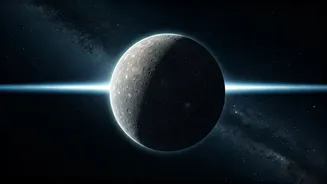
This is because our orbit around the sun is very long compared to our quick daily rotation. But on Mercury, these two definitions of a 'day' are wildly different. The headline’s 59 days refers to how long it takes Mercury to complete one full rotation on its axis. This is its sidereal day. However, if you were standing on its surface waiting for the sun to return to the same spot in the sky, you’d be waiting a lot longer. A solar day on Mercury is a whopping 176 Earth days long. That means one full day-night cycle on Mercury lasts longer than two of its years!
The Planet's Peculiar Pace
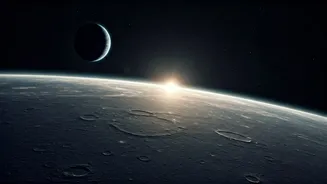
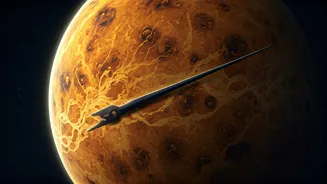
So, what causes this massive difference? It's all about a strange relationship between Mercury's spin and its journey around the Sun. Mercury rotates on its axis incredibly slowly—taking 59 Earth days to complete one turn. At the same time, it zips around the Sun very quickly, completing a full orbit in just 88 Earth days. For comparison, Earth takes 365 days to orbit the Sun while spinning on its axis every 24 hours. Mercury’s combination of a slow spin and a fast orbit creates a bizarre effect. As it slowly rotates, it’s also moving a significant distance along its orbital path. This means the planet has to rotate much more than once for the Sun to appear in the same position in the sky, stretching its solar day to that staggering 176-day length.
A Cosmic 3:2 Rhythm
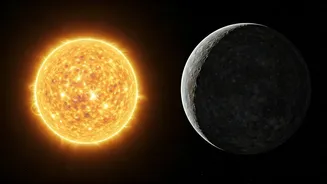
This isn't a random coincidence. Astronomers call this phenomenon a 'spin-orbit resonance'. Mercury is tidally locked with the Sun in a unique 3:2 ratio. This means that for every two orbits it completes around the Sun (2 x 88 = 176 days), it rotates on its axis exactly three times (3 x 59 ≈ 176 days). This gravitational lock is the result of the Sun's immense pull on the small, dense planet. For a long time, scientists believed Mercury was fully tidally locked, with one side always facing the Sun, just as the Moon is with Earth. But radar observations in the 1960s revealed this more complex and fascinating 3:2 dance. This precise rhythm is what governs the extreme lengths of its days and years, making it one of the most unique timers in our solar system.
A Sun That Moves Backwards
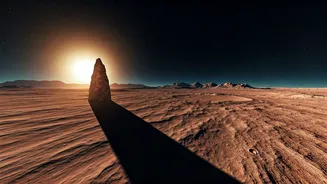
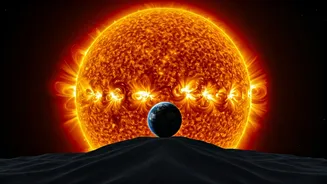
The experience of watching the Sun from Mercury’s surface would be surreal. Because of its eccentric, egg-shaped orbit, Mercury’s orbital speed changes. When it’s closest to the Sun (at perihelion), it moves so fast in its orbit that its orbital motion actually overtakes its rotational speed. For an observer on the surface, this would cause the Sun to briefly stop, move backwards in the sky for a few Earth days, and then resume its forward path. This phenomenon is known as 'retrograde motion'. Imagine watching a sunrise where the Sun pops above the horizon, hangs there, dips back below, and then rises again. This double sunrise occurs only in certain locations on the planet, adding another layer of weirdness to its already extreme environment, which swings from scorching temperatures of 430°C in the day to a freezing -180°C at night.