








The Allure of a Simple Myth
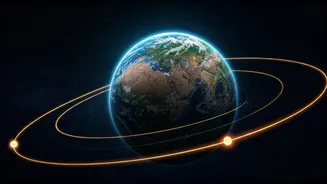
The idea that our distance from the Sun dictates our seasons feels like common sense. After all, the closer you are to a campfire, the warmer you feel. Earth's orbit isn't a perfect circle; it's a slight ellipse. This means our distance from the Sun does
change throughout the year. At its closest point, called perihelion, Earth is about 147.1 million kilometres away. At its farthest point, aphelion, it's about 152.1 million kilometres away. That's a difference of about 5 million kilometres. While that sounds like a lot, it has a surprisingly small effect on our overall climate and is not the primary driver of the seasons. The real proof lies in the timing.
A Tilted Reality
The true cause of the seasons is that our planet is tilted. Earth’s axis—the imaginary pole it spins around—is not straight up and down relative to its orbit around the Sun. Instead, it’s tilted at an angle of about 23.5 degrees. This tilt is believed to be the result of a massive object, sometimes called Theia, colliding with a young Earth billions of years ago. As Earth makes its year-long journey around the Sun, that axis always points in the same direction in space. This constant tilt means that for half the year, the Northern Hemisphere is pointed more towards the Sun, and for the other half, the Southern Hemisphere gets the spotlight.
Direct vs. Indirect Sunlight
The 23.5-degree tilt determines how directly the Sun's rays hit the ground. Think of it like a flashlight beam. If you shine it straight down (at a 90-degree angle), the light is concentrated in a small, bright circle. This is direct light, and it delivers a lot of energy to a small area. This is what happens to the hemisphere tilted towards the Sun, resulting in summer. When this hemisphere receives more direct solar energy, temperatures rise, and we experience longer days. Conversely, if you shine the flashlight at a low angle, the beam spreads out over a much larger area, and the light in any one spot is weaker. This is indirect light. This is what happens during winter, when the hemisphere is tilted away from the Sun. The days are shorter, and the less concentrated energy results in colder temperatures.
The Ultimate Proof: Winter at Its Closest
Here is the fact that definitively debunks the distance myth for anyone in the Northern Hemisphere. Earth reaches perihelion, its closest point to the Sun, in early January. In 2026, for instance, this occurs on January 3rd. This is right in the middle of winter for countries like India. Conversely, Earth reaches aphelion, its farthest point from the Sun, in early July—at the height of the Northern Hemisphere's summer. On July 6, 2026, we will be at our most distant from the Sun, even as temperatures soar. This proves that the Earth's tilt is overwhelmingly the most significant factor in creating our seasons.
A Tale of Two Hemispheres
The axial tilt also explains why the Northern and Southern Hemispheres experience opposite seasons. When the North Pole is tilted towards the Sun, bringing summer to Europe and North America, the South Pole is tilted away. This means that while India experiences its summer monsoon, Australia is having its winter. Six months later, as the Earth continues its orbit, the situation is reversed. The Southern Hemisphere is tilted towards the Sun, enjoying the direct rays and long days of summer, while the Northern Hemisphere is tilted away, deep in winter. This perfect opposition is a direct consequence of our planet's persistent lean.