



The World's Largest Telescope
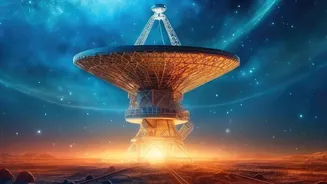
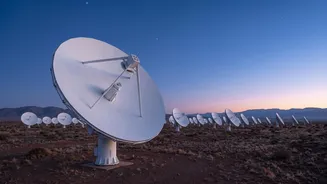
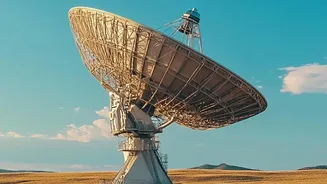
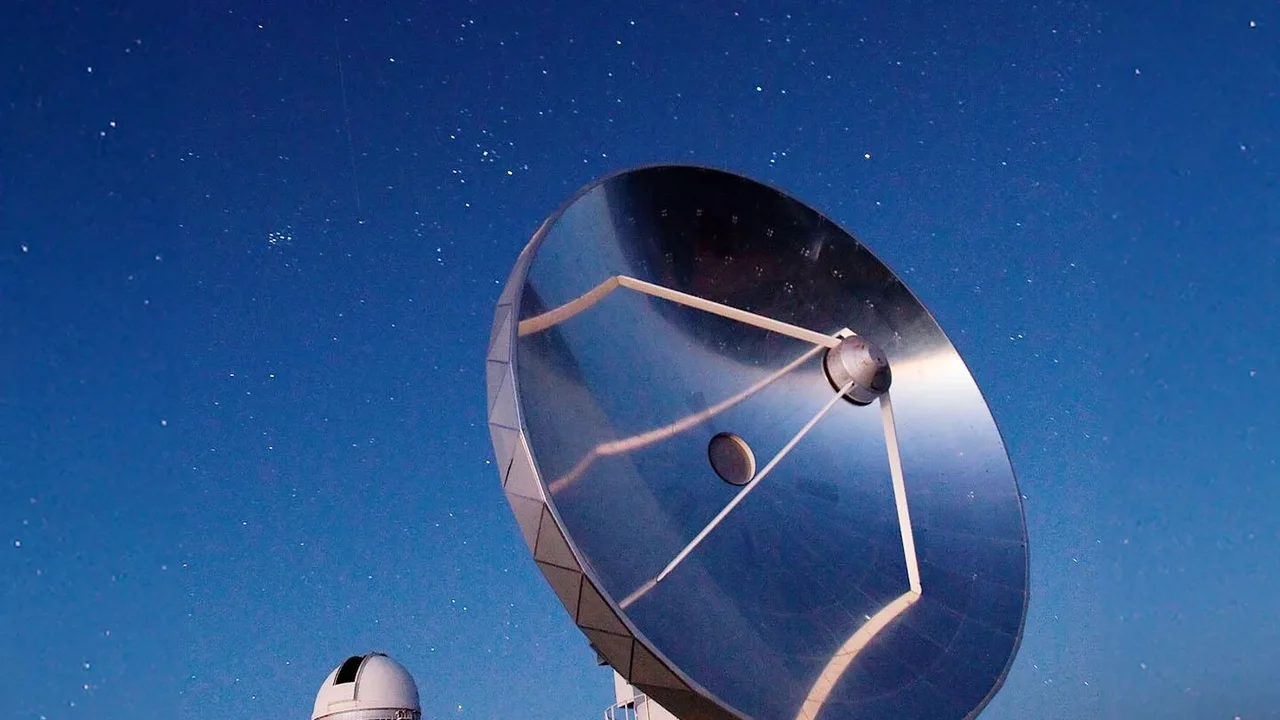
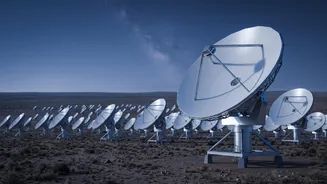
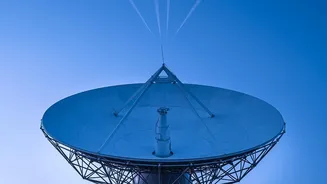
The Square Kilometre Array isn't a single instrument but a global scientific collaboration building the largest radio telescope ever conceived. It consists of two distinct arrays spread across two continents. In South Africa's remote Karoo region, an
array of 197 classic dish-shaped antennas, called SKA-Mid, is taking shape. Meanwhile, in the radio-quiet expanse of Western Australia, 131,072 small, tree-like antennas, known as SKA-Low, are being deployed. Together, they form a single, continent-spanning observatory, with its headquarters in the UK, involving thousands of scientists and engineers from over a dozen countries. The project is named for its ultimate ambition: to create a collecting area of one square kilometre, providing unparalleled sensitivity to the faintest radio signals from deep space.
Tuning Into the Cosmic Dawn
The SKA's primary target is one of the most mysterious periods in cosmic history: the 'Cosmic Dawn'. This era, from about 200 to 600 million years after the Big Bang, is when the universe emerged from a cosmic 'dark age' and the very first stars and galaxies began to shine. Their light started a process called the 'Epoch of Reionization', which fundamentally changed the structure of the cosmos. The SKA is designed to detect the faint, stretched-out radio signals from the neutral hydrogen gas that filled the universe during this period. By mapping this hydrogen, astronomers can essentially create a 3D picture of the early universe as it was first being lit up, watching the birth of the first celestial objects.
How an Array 'Listens'
So, how do thousands of antennas work together to 'listen' to something so ancient and faint? The technique is called interferometry. Instead of relying on one massive, impossibly large dish, the SKA connects many smaller antennas with thousands of kilometres of optical fibre cables. When a radio wave from space washes over the array, it hits each antenna at a slightly different time. By precisely measuring these tiny time differences, powerful supercomputers can combine the signals. This process, known as aperture synthesis, allows the array to function as a single virtual telescope as large as the distance between its farthest antennas—up to 150 km in South Africa and 74 km in Australia. This provides incredibly high resolution, allowing astronomers to see fine details, while the combined collecting area of all the antennas provides the sensitivity needed to detect the weakest signals.
Two Telescopes, Complementary Goals
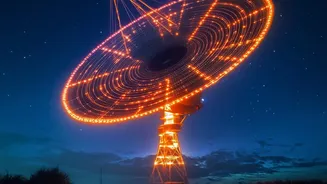
The two sites are not redundant; they look at different parts of the radio spectrum to achieve complementary science goals. The SKA-Low array in Australia, with its forest of 'Christmas tree' antennas, is designed to capture low-frequency radio waves. These are the signals that have travelled for billions of years from the Cosmic Dawn, their wavelengths stretched by the expansion of the universe. The SKA-Mid dishes in South Africa are tuned to mid-range frequencies. This makes them ideal for other groundbreaking research, such as mapping cosmic magnetism, testing Einstein's theories of gravity by timing pulsars with extreme precision, and searching for the faint ripples in spacetime known as gravitational waves.
A Data Deluge to Decode the Cosmos
The sheer volume of data the SKA will generate is staggering. The information flowing from the antennas to dedicated supercomputing centres in Cape Town and Perth will require processing power that ranks among the fastest in the world. These Science Data Processors will crunch the numbers, correcting for signal delays and combining the data streams to produce cosmic maps and images. The challenge is immense, requiring machine learning and advanced algorithms to sift through the noise and find the precious scientific information buried within. The resulting data will then be distributed to a global network of regional centres, allowing scientists everywhere to partake in the discoveries.