






A Race Against Time
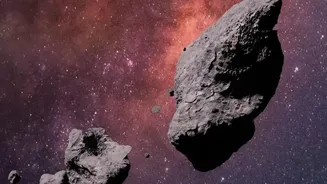
On September 6, 2026, astronomers at the Mount Lemmon Survey in Arizona spotted a faint, fast-moving object. Designated CERNQ52, it was tiny—estimated to be only about a metre in diameter. What made it extraordinary was its trajectory: it was on a direct
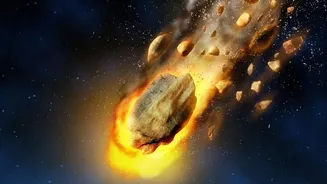
course with Earth. Just over seven hours after its discovery, the object, later named 2026 RW1, harmlessly disintegrated in a flash of light over the Indian Ocean. This event was the 13th time in history that an asteroid was detected before it impacted our atmosphere. While it sounds alarming, these last-minute discoveries aren’t a sign of failure. Instead, they are a powerful demonstration of how sophisticated our planetary defence systems have become.
The Sky's Digital Sentinels
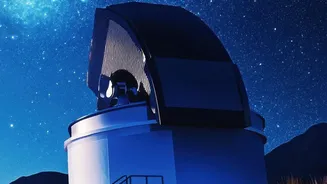
The secret to this rapid detection lies in a global network of robotic telescopes that act as our planet's early-warning system. Projects like the NASA-funded Catalina Sky Survey (CSS) and the Asteroid Terrestrial-impact Last Alert System (ATLAS) are at the forefront. Unlike traditional telescopes that focus on one small patch of sky, these are wide-field survey instruments. ATLAS, for example, consists of four telescopes spread across the globe—two in Hawai'i, one in Chile, and one in South Africa—allowing it to scan the entire dark sky every 24 hours. Each telescope repeatedly takes images of large swathes of the sky throughout the night. This rapid, repetitive scanning is key to spotting the faint, fleeting streaks of light that betray an asteroid's presence.
From Faint Dot to Flight Path
Detecting a dot moving against a background of stars is just the first step. Automated software is the real hero of the initial discovery, comparing a sequence of images taken minutes apart to flag any object that has changed position. Once a potential candidate is flagged, the clock starts ticking. The initial observations are immediately sent to the Minor Planet Center (MPC), the worldwide clearinghouse for all asteroid and comet data, operated under the International Astronomical Union. At the MPC, powerful computer programs analyse the data to calculate a preliminary orbit. However, a few data points from a single observatory aren't enough to be certain. The object’s position is published on a public confirmation page, calling on a global network of astronomers—both professional and amateur—to help.
A Global Collaboration
This is where the power of global collaboration shines. Observatories around the world scramble to point their telescopes at the specified coordinates to get more data points. Each new observation helps refine the asteroid’s orbit, shrinking the zone of uncertainty. Systems like NASA's Sentry and the European Space Agency's NEODyS independently calculate the impact risk. For a small object like 2026 RW1, this process—from initial detection to a confirmed impact prediction—happened in just a few hours. This rapid coordination allows scientists to predict not just that an impact will happen, but with increasing accuracy, where and when it will occur.
Why Are They Found So Late?
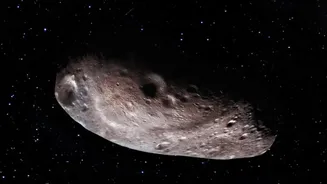
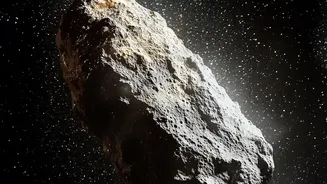
If our systems are so good, why do we only find these asteroids hours before they arrive? The answer is simple: size and brightness. The asteroids detected just before impact are typically very small, often only a few metres across. These objects are incredibly faint and don't reflect much sunlight, making them virtually invisible until they get very close to Earth. Our sky surveys are excellent at finding large, 'planet-killer' asteroids that are a kilometre or more in diameter; we've already tracked over 95% of them, and none pose a threat for the foreseeable future. The last-minute discoveries are of the much more common, but far less dangerous, small asteroids that are too small to cause significant damage and usually burn up completely in the atmosphere.
A Valuable Test Run
Finding these small impactors is far from pointless. Each one provides a real-world test of our entire planetary defence pipeline, from detection and tracking to communication and prediction. They allow scientists to stress-test their models and improve their response times. Furthermore, if any fragments—called meteorites—survive the fiery descent and are recovered, they offer an invaluable, free sample of an asteroid, giving us clues about the building blocks of our solar system. As technology improves, with upcoming projects like the Vera C. Rubin Observatory, our ability to detect even smaller objects, and to find them earlier, will only get better.