






The Full Dress Rehearsal: Uncrewed Missions
Before any astronaut steps into the crew module, ISRO has planned a series of uncrewed flights to test the entire system from end to end. The first of these, G1, will be a full dress rehearsal. It will validate the performance of the human-rated LVM3
launch vehicle, the orbital module's systems, and the crucial re-entry and recovery operations. These flights will demonstrate that the spacecraft can perform its journey flawlessly without a crew, proving the technology's readiness and reliability under real-world conditions before risking human lives.
Meet Your Robotic Co-Passenger: Vyommitra
A key passenger on these uncrewed flights will be 'Vyommitra', a sophisticated humanoid robot developed by ISRO. Derived from the Sanskrit words for "space" and "friend," Vyommitra is designed to mimic human functions. It will occupy the astronaut's seat to help scientists understand how the flight conditions, including launch vibrations and microgravity, might affect the human body. Vyommitra can operate switch panels, monitor environmental controls, and communicate with ground control, providing invaluable data on the cabin environment and life support systems before the first crewed mission.
The Great Escape: Crew Escape System Tests
Human spaceflight is inherently risky, especially during launch. ISRO has developed a Crew Escape System (CES) designed to pull the crew module and its astronauts to safety in the event of an emergency on the launchpad or during ascent. This system has been, and continues to be, validated through multiple trials, including the Pad Abort Test (PAT). A successful PAT in 2018 demonstrated the system's ability to jettison the crew capsule to a safe distance from a simulated emergency on the ground. As designs evolve, these abort tests are repeated to ensure the escape mechanism is foolproof.
The Slowdown: Parachute System Validation
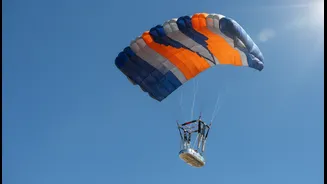
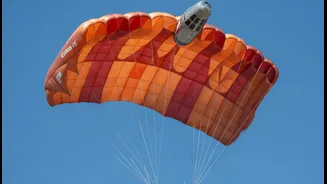
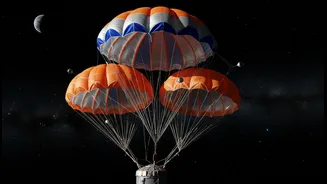
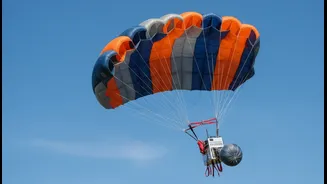
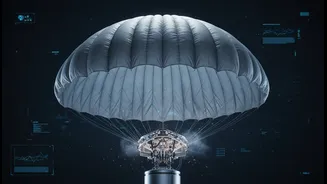
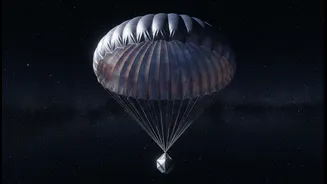
Returning to Earth safely is just as important as launching successfully. The Gaganyaan crew module will re-enter the atmosphere at high speed and must be slowed down for a gentle splashdown in the sea. This is achieved through a complex sequence of parachutes. ISRO is conducting a series of Integrated Air Drop Tests (IADT), where a simulated crew module is dropped from a helicopter to test the deployment of the entire parachute system, from the initial small drogue parachutes to the three massive main parachutes that ensure a soft landing. Recent tests in 2025 and 2026 have successfully validated this critical system. To further enhance testing, ISRO is developing a new rocket called SOLVE (Sub-Orbital Launch Vehicle for Experiments) specifically to carry the crew module to higher altitudes (10-17 km) and test the parachute system under more varied and mission-relevant conditions.
The Lifeblood: Environmental Control Systems
Astronauts need an Earth-like environment to survive in the vacuum of space. The Environmental Control and Life Support System (ECLSS) is responsible for this. This system provides breathable air, manages temperature and humidity, controls cabin pressure, and handles waste. ISRO is developing this critical technology indigenously and is conducting extensive ground tests to ensure it can reliably maintain a safe and comfortable habitat for the crew throughout their three-day mission. The system must remove carbon dioxide, prevent the buildup of toxic gases, and even suppress fires in microgravity.