

An Invisible Junkyard Above Us
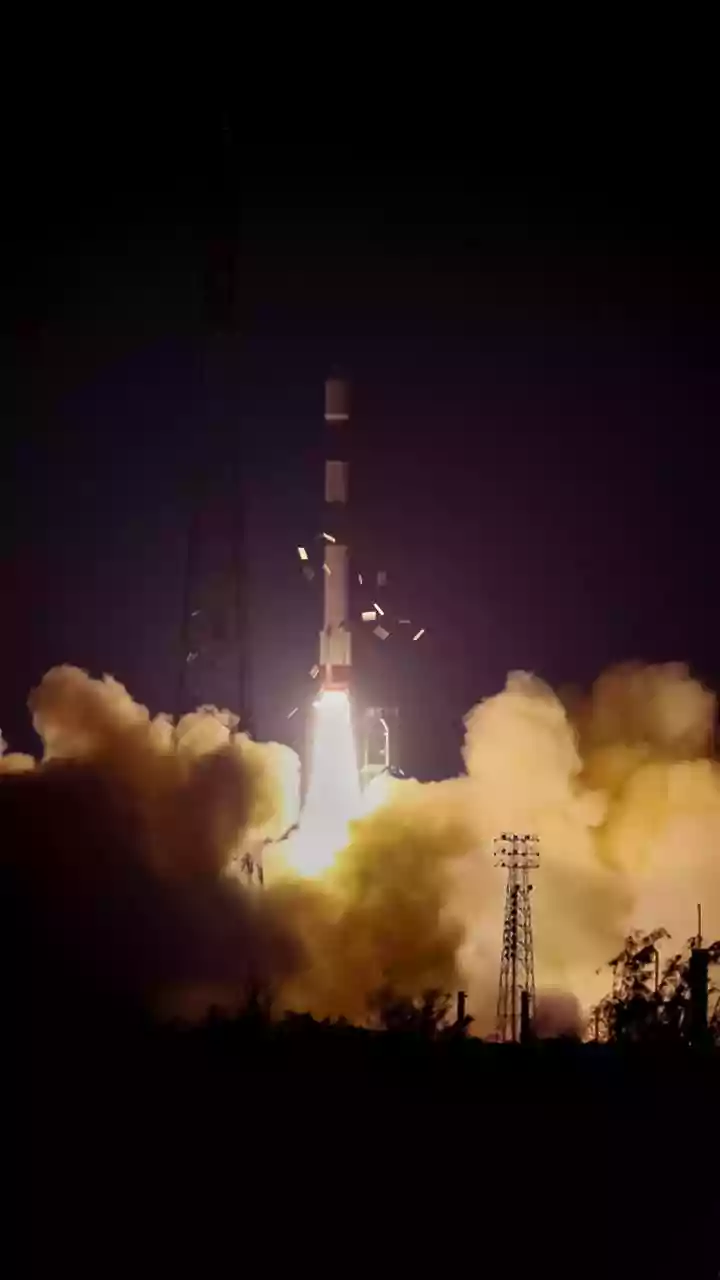
Since the launch of Sputnik 1 in 1957, humanity has placed thousands of satellites into orbit. While many are still active, a huge number are now defunct, alongside spent rocket stages, and fragments from past collisions. The European Space Agency (ESA)
estimates there are over 34,000 objects larger than 10 cm being tracked. These objects travel at incredible speeds, over 28,000 kilometres per hour, where even a tiny paint flake can strike an operational satellite with the force of a hand grenade. This orbital debris poses a significant risk to active satellites responsible for everything from your GPS navigation to weather forecasting and global communications.
The Kessler Syndrome Threat
The problem is not just the existing debris, but the potential for a chain reaction. This scenario, known as the Kessler Syndrome, was proposed by NASA scientist Donald Kessler decades ago. He theorised that if the density of objects in low-Earth orbit becomes too high, a single collision could generate a cloud of new debris, which in turn increases the probability of more collisions. This cascading effect could eventually render certain orbits unusable for generations. Even if all space launches stopped today, the amount of debris would likely continue to increase due to existing objects colliding. This makes active debris removal not just a good idea, but a necessity.
Enter the Debris Removal Arsenal
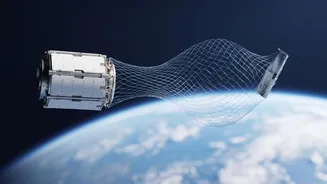
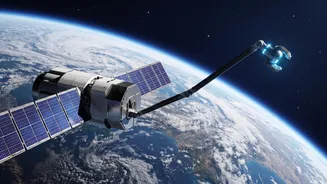
The headline 'laser harpoons' paints a wonderfully futuristic picture, but it's a simplification of a suite of sophisticated technologies being developed. The two primary concepts are 'contact' methods like harpoons and nets, and 'contactless' methods like lasers. A harpoon, like one tested by the RemoveDEBRIS mission, is designed to physically capture a large, defunct satellite. It fires a projectile that pierces the target's hull, deploying barbs to secure a firm grip. A tether then allows a 'chaser' spacecraft to pull the captured debris into a new trajectory, causing it to burn up safely in Earth's atmosphere.
Lasers: The Contactless Approach
Lasers offer a different strategy, particularly for smaller debris or for nudging larger objects without physical contact. One method is called laser ablation. A powerful laser, either from the ground or a dedicated satellite, focuses a beam onto a piece of debris. The intense energy vaporises a tiny part of the object's surface, creating a small jet of plasma that acts like a micro-thruster, pushing the object and altering its orbit. The goal is to nudge the debris onto a path where it will re-enter and disintegrate in the atmosphere. This method avoids the risk of creating more fragments that can come from a physical impact.
The Teams Racing to Clean Up Space
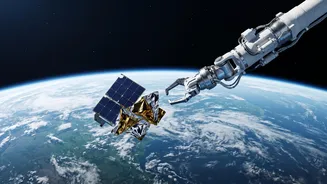
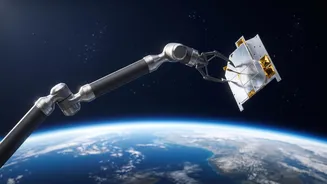
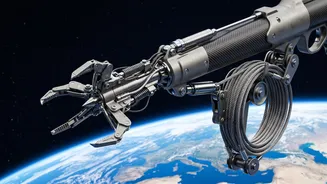
This isn't just science fiction; major space agencies and private companies are actively developing and testing these solutions. The European Space Agency is a key player, with its Clean Space initiative backing missions like ClearSpace-1, which aims to use a four-armed claw to capture and de-orbit a piece of debris. Commercial companies like the Japan-based Astroscale and Airbus are also at the forefront. Astroscale has demonstrated magnetic docking technology, while Airbus developed the harpoon system tested in the RemoveDEBRIS mission. These efforts are increasingly collaborative, involving partnerships between government agencies and innovative startups to accelerate progress.
The Challenges of cosmic Cleanup
Cleaning up space is extraordinarily difficult. The targets are not stationary; they are often tumbling uncontrollably at high speeds, making capture a delicate and dangerous manoeuvre. A harpoon must strike a part of the satellite, like the reinforced structure, while avoiding things like leftover fuel tanks which could cause an explosion. Furthermore, any capture attempt gone wrong risks creating even more debris. For lasers, the challenge lies in generating enough power and precision to affect an object's orbit from potentially thousands of kilometres away. Despite these hurdles, the consensus is clear: the cost of inaction is far greater than the challenge of developing these incredible new technologies.