



What Exactly Is This 'Cosmic Alignment'?
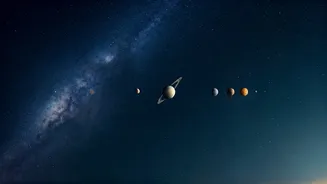
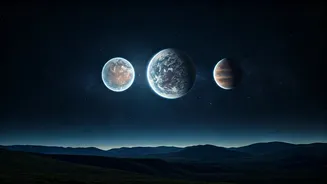
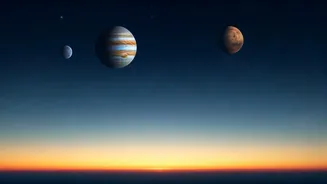
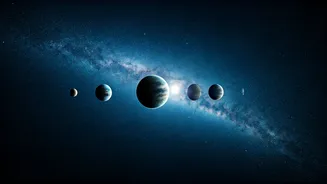
First, let's manage expectations. While the term 'alignment' might conjure images of planets forming a perfectly straight line in space, the reality is a little different—and arguably, more beautiful. A planetary alignment, often called a 'planetary parade',
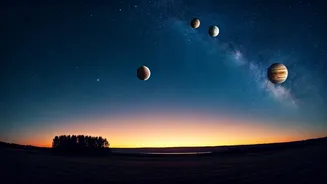
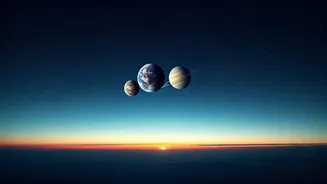
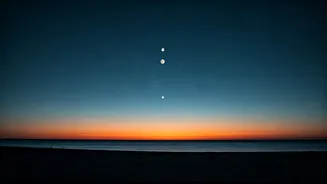
occurs when several planets appear close together in a small sector of the sky from our perspective on Earth. They aren't actually physically close to each other in space; in fact, they remain millions of kilometres apart. Instead, as they travel in their own orbits around the Sun, they occasionally fall into the same line of sight for us stargazers. Think of it like seeing several distant ships on the horizon that appear grouped together, even though they are miles apart on the vast ocean.
Which Planets Can You See?
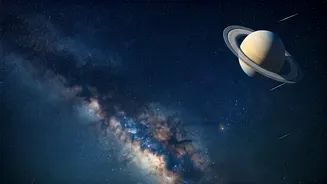
Tonight's event is special because it brings together a lineup of planets that are often scattered across the sky. Depending on the exact time you look, you may be able to spot Mercury, Venus, Mars, Jupiter, and Saturn. Venus, the brightest of the lot, will be unmistakable as a brilliant, steady light. Jupiter will also shine brightly, outshining all the stars. Mars will be identifiable by its distinct reddish-orange hue. Saturn, fainter than Jupiter and Venus, will appear as a steady, yellowish point of light. Mercury is the trickiest to spot as it’s always close to the Sun, so it will only be visible for a short window just before sunrise or just after sunset, low on the horizon. Seeing five planets at once is a treat that doesn't happen every year.
The Best Time and Direction to Watch in India
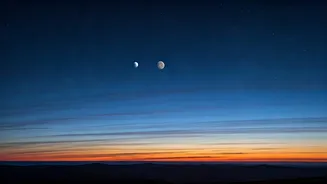
The prime viewing window for this celestial show is in the pre-dawn hours. For the best experience, plan to be outside about 45 to 60 minutes before your local sunrise. Find a spot with a clear view of the eastern horizon. The planets will be strung out in a diagonal line, following what astronomers call the ecliptic—the path the Sun, Moon, and planets appear to take across our sky. Because this is a large-scale event spanning a wide arc of the sky, it will be visible from anywhere in India, provided the skies are clear. Monsoon clouds could play spoilsport in some regions, so be sure to check your local weather forecast.
Do I Need a Telescope?
The best part about this event is its accessibility. You don’t need any fancy equipment to enjoy the basic alignment. All the visible planets—especially Venus and Jupiter—are bright enough to be seen with the naked eye, even from moderately light-polluted cities. However, if you have a pair of binoculars, you’ll get an even better view. Binoculars can help you pick out the colour of Mars more clearly and might even reveal a hint of Jupiter's largest moons as tiny pinpricks of light right next to the planet. If you are lucky enough to have a small telescope, you'll be in for a real treat. Pointing it at Saturn could reveal its iconic rings, a sight that never fails to inspire awe.
Tips for the Best Viewing Experience
To make the most of this cosmic event, follow these simple tips. First, find the darkest spot you can. The less light pollution from streetlights and buildings, the more stars and planets you'll see. Even moving to a local park, a rooftop, or the edge of your town can make a huge difference. Second, give your eyes time to adjust. It takes about 15-20 minutes for your eyes to become fully dark-adapted, which will allow you to see fainter objects. Avoid looking at your bright phone screen during this time. If you need a light, use a red torch, as red light is less disruptive to your night vision. Finally, consider using a stargazing app on your phone (like Stellarium or SkyView) beforehand to identify where the planets will be. It can act as your digital guide to the cosmos.