



The Universe’s Giant Magnifying Glass
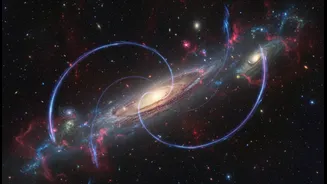
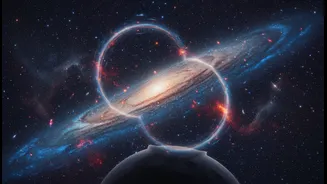
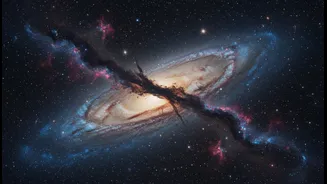
Imagine a magnifying glass the size of a galaxy. That’s essentially a gravitational lens. First predicted by Albert Einstein, this phenomenon occurs when a massive object, like a galaxy or a cluster of galaxies, sits between us and a more distant object.
The immense gravity of the foreground object warps the fabric of spacetime, bending the light from the background source as it travels toward us. This can result in magnified, distorted, or even multiple images of the distant source. Astronomers have used this effect for decades as a natural telescope, allowing them to study faint, faraway galaxies that would otherwise be invisible and to map the distribution of mysterious dark matter.
Hunting for Cosmic Ghost Particles
Then there are neutrinos. These fundamental particles are often called 'ghost particles' because they have almost no mass and no electric charge, meaning they rarely interact with other matter. Trillions of them pass through you every second without a trace. But this same quality makes them invaluable to astronomers. Unlike light, which can be blocked by gas and dust, neutrinos can travel across the universe from the heart of the most violent cosmic events, like exploding stars or supermassive black holes, completely unimpeded. This makes neutrino astronomy a unique window into processes that are otherwise hidden from our view. A recent finding, for example, has pointed to a galaxy nicknamed the 'Shadow Blaster' as a potential source of high-energy neutrinos, with the engine being a burst of star formation rather than a black hole.
The Blurry Signal Problem
The biggest challenge in neutrino astronomy is pinpointing where these particles come from. Because they are so difficult to detect, observatories like the giant IceCube in Antarctica can spot high-energy neutrinos arriving from a general direction, but tying them to a single, specific source is incredibly difficult. Scientists are often left with a diffuse glow of neutrinos coming from all over the sky, making it hard to say with certainty whether a specific galaxy or star is responsible. This is the problem of 'single-source certainty'. While there have been promising associations, no single detection has yet met the 'gold standard' for discovery, leaving the precise origins of many cosmic neutrinos an open question.
A Hypothetical 'Blaster' Solution
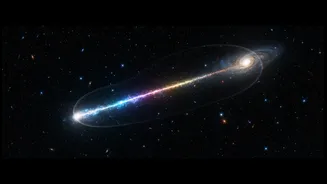
This is where the concepts of a 'Shadow Blaster Neutrino Source' and gravitational lensing could theoretically intersect. While the term itself isn't established, it represents a powerful idea: what if you had a focused, artificial source of neutrinos that you could aim through space? Now, imagine aiming that beam so that it passes by a massive object, like our own Sun. The Sun itself acts as a gravitational lens for neutrinos. Unlike light, neutrinos can pass directly through the Sun's core, which could, in theory, improve the focus of the lens. A hypothetical 'blaster' or a precisely known natural source could act as a calibration tool. By knowing the exact origin of the neutrinos and observing how they are bent by a gravitational lens, we could map that lens with unprecedented accuracy.
A Sharper View of the Cosmos?
If you can perfectly map a gravitational lens, you can then use it to study other, unknown particles passing through it more effectively. A hyper-accurate lens map could help de-blur the signals from distant natural neutrino sources. When a cosmic neutrino arrives, astronomers could better account for the gravitational bending it experienced, tracing its path back to its origin with much greater precision. This would directly address the 'single-source certainty' problem. It could help confirm whether suspected sources, like active galactic nuclei or the 'Shadow Blaster' galaxy, are truly the powerful particle accelerators we think they are. This remains highly theoretical, as creating a powerful, directional neutrino beam is far beyond current technology. However, the prospect of using one cosmic phenomenon to sharpen our view of another represents a fascinating frontier in our quest to understand the universe.