


A Familiar, Yet Mysterious, Neighbor
At just 11 million light-years away, Centaurus A is a close neighbor in cosmic terms. For centuries, astronomers have been captivated by its strange appearance: a giant, glowing elliptical galaxy sliced in half by a dark, thick lane of dust. This unusual
structure made it a prime target for study, but also a source of frustration. The very dust that made it so distinctive also acted like a thick curtain, hiding the galaxy's heart from view. Telescopes like Hubble, which see in visible light, could only capture the obscuring dust lanes. Even earlier infrared observatories like the Spitzer Space Telescope could see the larger structures but lacked the power to resolve fine details. Centaurus A was a known puzzle, a story half-told, waiting for a tool powerful enough to read its hidden chapters.
Webb's Infrared Revolution
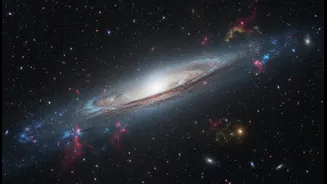
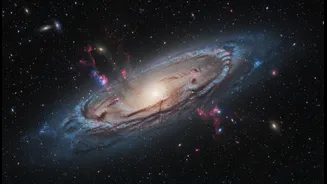
Enter the James Webb Space Telescope (JWST). To celebrate its fourth year of science operations, NASA released these stunning new images of the galaxy. Webb’s superpower is its ability to see the universe in infrared light, which can pass through cosmic gas and dust that visible light cannot penetrate. This makes it the perfect tool for galactic archaeology. Where Hubble saw an impenetrable wall of dust, Webb sees a rich tapestry of millions of individual stars and glowing gas clouds. It has transformed a familiar galaxy into something far more complex and detailed than ever seen before, finally revealing the engine room at the heart of this cosmic powerhouse.
Anatomy of a Galactic Smash-Up
The new images provide the clearest evidence yet of the galaxy's violent past. Roughly two billion years ago, Centaurus A, then a large elliptical galaxy, collided with a smaller spiral galaxy. This catastrophic event wasn't just destructive; it was creative. The merger funneled enormous amounts of gas and dust into the galaxy's center, triggering a massive burst of star formation. Webb's images show the aftermath in exquisite detail: a warped, parallelogram-shaped disk of gas and dust left behind by the collision. Within this structure, Webb can resolve individual stars, allowing scientists to create a timeline of the galaxy's life, pinpointing which stars existed before the merger and which were born from the chaos.
Feeding a Supermassive Monster
At the very center of all this activity lies a supermassive black hole, 55 million times the mass of our sun, and the collision has been providing it with a feast. As gas and dust from the merger fall into the black hole, it becomes an 'active galactic nucleus' (AGN), unleashing enormous amounts of energy and blasting out powerful jets of plasma at nearly half the speed of light. Webb's instruments can measure the motion of gas swirling around this cosmic engine. The new data shows fast-moving ionized gas being pushed outward by the black hole's activity, while other gas clouds rotate in a warped disk nearby. This provides a rare, close-up look at a process that shapes galaxies across the universe.
A Cosmic Laboratory for Creation and Destruction
Perhaps the most fascinating insight from Webb's observations is the complex relationship between the black hole and its host galaxy. The data suggests the black hole is a dual-natured force. On one hand, its powerful outflows can push away the raw material needed for star formation, potentially stunting the galaxy's growth. On the other hand, the pressure from these same jets can compress gas clouds, triggering new bursts of star birth. Centaurus A serves as a perfect nearby laboratory for studying this cosmic interplay. The images even revealed a mysterious S-shaped structure near the core that scientists are now working to understand, a feature that may be linked to both the ancient collision and the black hole's ongoing activity.