





Saturn Puts on Its Best Show of the Year
The absolute highlight for October is the planet Saturn, which reaches opposition on October 4. Opposition is the point in a planet's orbit when it is directly opposite the Sun from our perspective on Earth, making it appear at its biggest and brightest
for the year. For observers in India, this means Saturn will rise in the east around sunset, remain visible all night long, and set in the west around sunrise. On the evening of October 4, Saturn will rise at approximately 6:11 PM IST and be visible throughout the night, reaching its highest point just after midnight. While the planet will be bright enough to be seen with the naked eye as a steady, yellowish point of light, a small telescope will reveal its famous rings. The weeks surrounding October 4 are also excellent for viewing the ringed planet.
Catch a 'Shooting Star' from Halley's Comet
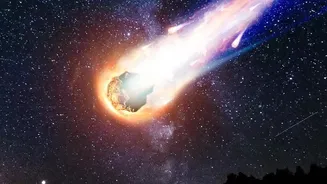
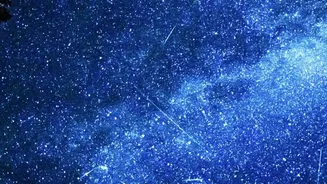
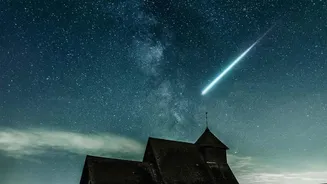
October hosts the reliable Orionid meteor shower, which is active from early October to early November. The shower is predicted to reach its peak on the night of October 21-22. These meteors are actually tiny dust particles left behind by the famous Halley's Comet. When these particles burn up in Earth's atmosphere, they create fast, bright streaks of light that appear to radiate from the constellation Orion. Viewers can expect to see up to 15-20 meteors per hour under ideal, dark-sky conditions. This year, a bright waxing gibbous Moon will be present during the peak, which may wash out some of the fainter meteors. For the best chance of spotting them, NASA suggests looking up in the few hours before dawn on October 22, after the Moon has set.
More Meteors and Dazzling Clusters
Before the Orionids peak, the Draconid meteor shower offers another chance to see shooting stars, peaking on the night of October 8-9. This is a much quieter shower, typically producing about 10 meteors per hour, but it has the advantage of being best viewed in the early evening, just after sunset. Later in the month, on the night of October 27-28, the Moon will pass close to the beautiful Pleiades star cluster, also known as the Seven Sisters. This grouping of bright stars is easily visible to the naked eye and looks like a tiny, shimmering ladle in the sky. It offers a stunning sight through a pair of binoculars.
The Hunter's Moon and Other Sights
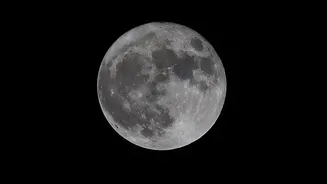
The full moon of October, known as the Hunter's Moon, will reach its peak illumination on October 26. The name is a traditional one, tied to the time of year when fields were cleared after harvest, making it easier for hunters to spot prey under the bright moonlight. For viewers in India, the Moon will appear fullest on the evening of October 25 and the morning of October 26. Also, keep an eye out before sunrise throughout the month. On the morning of October 6, a thin crescent Moon can be seen close to the brilliant planet Jupiter, creating a lovely pairing in the pre-dawn sky.
Tips for the Best Viewing Experience
To make the most of these celestial events, the first step is to get away from bright city lights. Light pollution washes out all but the brightest objects in the night sky. Find a location with a clear, unobstructed view of the horizon, such as a rural area, a local park on the outskirts of town, or a hilltop. Give your eyes about 20-30 minutes to fully adapt to the darkness; this will help you spot fainter meteors and stars. For meteor showers, no special equipment is needed. Just lie back on a blanket or reclining chair and look up. For viewing Saturn's rings or the craters of the Moon, even a basic pair of binoculars or a small telescope will dramatically enhance your experience.