

A Tiny Speck, A Giant Puzzle
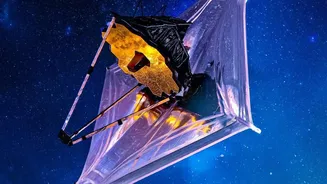
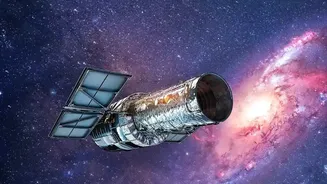
Since it began sending back data in 2022, the James Webb Space Telescope has been discovering objects that have left astronomers scrambling for explanations. Among the most perplexing are the 'little red dots' (LRDs). These are compact, reddish objects that appear
in large numbers in the very early universe, around 600 million years after the Big Bang, but then seem to vanish from view as the cosmos ages. Initially, their existence was a shock. Some theories suggested they might be incredibly massive galaxies that formed far too quickly, seemingly 'breaking' our standard models of cosmology. If they were galaxies, their brightness implied they were more massive than our own Milky Way, a feat considered impossible so early in cosmic history when the building blocks of galaxies were still scarce. This contradiction sent ripples through the scientific community, forcing a deeper look at these enigmatic points of light.
More Than Meets the Eye
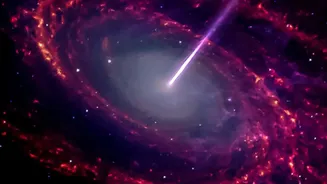
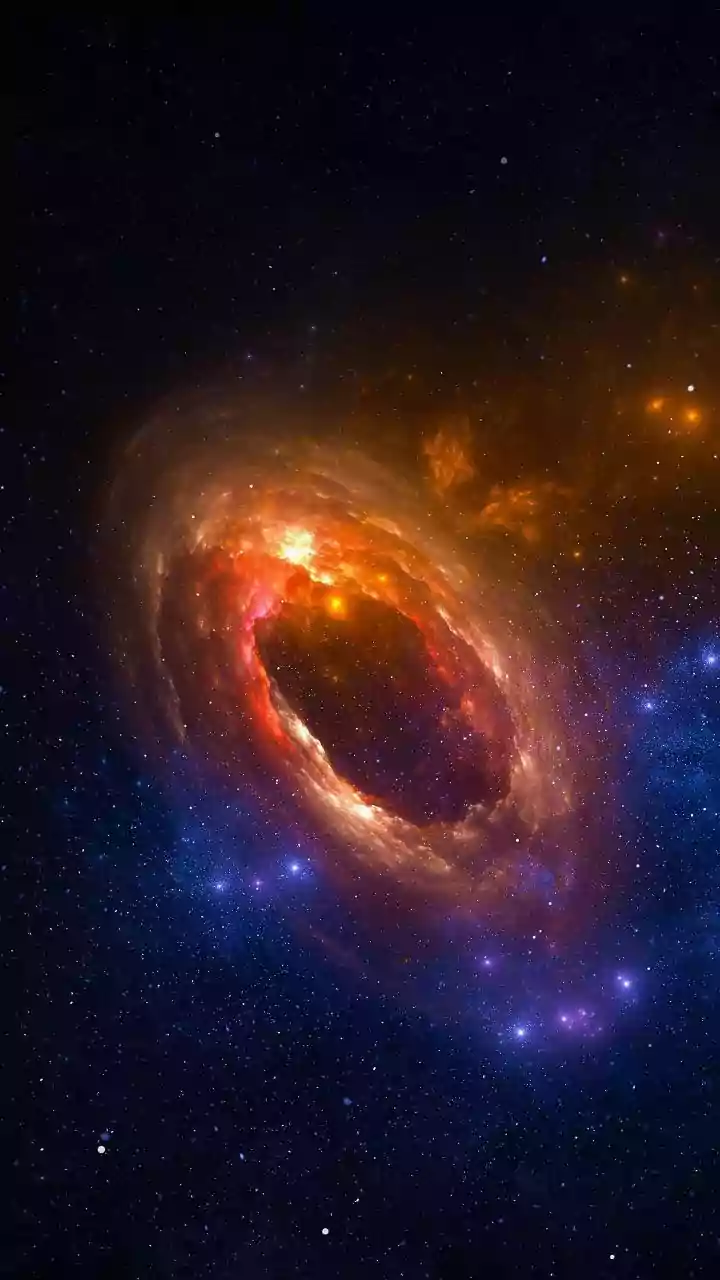
The simple idea of a 'dot' being a distant galaxy proved insufficient. The headline-grabbing theory that these LRDs were 'universe breakers' pushed scientists to explore other, more exotic possibilities. Two main theories emerged to explain their unusual nature. One proposed they were extremely dusty, dense young galaxies. Another, more intriguing theory suggested they weren't galaxies at all, but a completely new type of object: a supermassive black hole feasting on gas and dust. This latter idea has been gaining significant traction. This model proposes that what we see as a 'red dot' is actually a rapidly growing black hole shrouded in a thick cocoon of gas. The intense energy from the black hole heats this cocoon, causing it to glow brightly in the infrared wavelengths that Webb is uniquely equipped to see.
Unmasking a 'Black Hole Star'
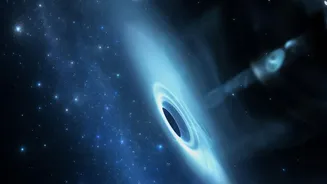
Recent studies have provided the strongest evidence yet for the black hole theory. One team focused on a specific little red dot named GLIMPSE-17775. By capturing the most detailed spectrum of light from an LRD to date, they found multiple signs that it was what scientists call a 'black hole star'—a supermassive black hole enveloped in a dense cloud of partially ionized gas. The light signature from the gas didn't match what would be expected from a typical galaxy of stars. Instead, it showed signs of being processed through a hot, dense cocoon, exactly as the black hole model predicts. This finding helps solve the 'universe breaker' problem, as the object's extreme brightness comes from the voracious black hole, not an impossibly massive collection of stars.
A Temporary Phase in Cosmic Evolution
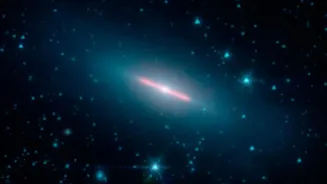
So why do these little red dots seem to disappear as the universe matures? The latest research suggests they don't vanish but instead evolve. Astronomers believe the LRD phase is a short-lived, intense growth spurt for supermassive black holes. Eventually, the black hole either consumes the surrounding gas or blows it away, revealing itself as a more conventional active galactic nucleus (AGN) at the center of a galaxy. In July 2026, a study of a nearby spiral galaxy nicknamed 'Saguaro' provided a potential link. Its center behaves just like an LRD. When scientists simulated what Saguaro would look like if it were much farther away in the early universe, its sprawling spiral arms vanished, leaving only the bright, compact red core visible—just like the dots Webb discovered. This suggests some LRDs could be the bright hearts of much larger galaxies whose fainter structures are simply too distant for even Webb to see clearly.