


A New Eye on the Cosmos
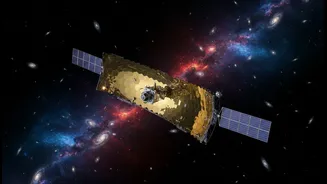
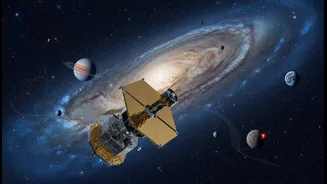
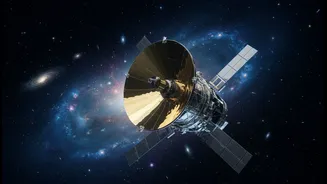
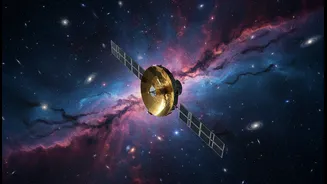
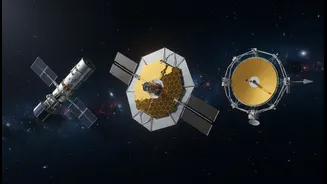
Set to launch in the latter half of the 2020s, NASA's Nancy Grace Roman Space Telescope is a next-generation observatory with a monumental task. Named after NASA's first chief of astronomy, the 'Mother of Hubble' Nancy Grace Roman, this telescope is designed
to peer into the vast darkness and hunt for answers to some of science's most profound questions. While it has a primary mirror the same size as the Hubble Space Telescope, Roman's key advantage is its incredible field of view. Its Wide Field Instrument will be able to capture an area of the sky at least 100 times larger than Hubble can in a single snapshot. Think of it as trading a keyhole view for a massive panoramic window, allowing astronomers to create sweeping maps of the universe with unprecedented speed and efficiency.
The Universe's Greatest Mystery
So what is this enigma that Roman is built to investigate? In the late 1990s, astronomers made a shocking discovery: the expansion of the universe isn't slowing down due to gravity as expected; it's speeding up. To explain this acceleration, scientists proposed the existence of 'dark energy,' a placeholder name for this unknown repulsive force. It's thought to make up a staggering 68% of the entire universe, yet we know almost nothing about it. Is it a constant energy inherent in the vacuum of space, something Einstein called his 'biggest blunder' before it was reconsidered? Or is it a new, evolving energy field, sometimes called 'quintessence'? These are the questions Roman will help answer by observing how dark energy has influenced the cosmos over billions of years.
How to Hunt for a Ghost
You can't see dark energy directly, so Roman will hunt for its effects. One of its primary methods is to search for a specific type of exploding star known as a Type Ia supernova. These explosions always have a similar peak brightness, which allows astronomers to use them as 'standard candles' to measure cosmic distances. By finding thousands of these supernovae across cosmic time and measuring how their light has been stretched by the expanding universe, Roman will create a detailed history of cosmic expansion. This will reveal how the push of dark energy has competed against the pull of gravity throughout the universe's history.
Mapping the Cosmic Web
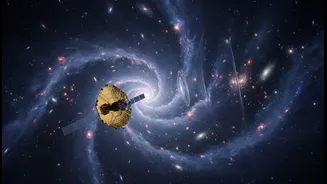
Another powerful technique involves mapping the 3D structure of the universe on the largest scales. Roman will survey the positions of hundreds of millions of galaxies to study how they are clustered. This 'cosmic web' holds clues about the forces shaping it. Dark energy's accelerating push works against gravity's pull, influencing how galaxies clump together over eons. Roman will also study the subtle distortions in the light from distant galaxies, a phenomenon called weak gravitational lensing. This allows astronomers to map the distribution of all matter, including the invisible dark matter, providing another line of evidence to test theories of dark energy and gravity.
More Than Just Dark Energy
While unraveling the mystery of cosmic expansion is its main goal, Roman's powerful capabilities will drive discoveries across all of astrophysics. Its wide, deep surveys will be a treasure trove for finding thousands of planets beyond our solar system, or exoplanets, using a technique called gravitational microlensing. This method can find planets much farther from their stars than other techniques allow. The telescope also carries a Coronagraph Instrument, a technology demonstration designed to block the overwhelming glare of stars, which will enable the direct imaging of giant exoplanets. From surveying our own Milky Way to spotting distant black holes, Roman is poised to revolutionize our cosmic perspective.