




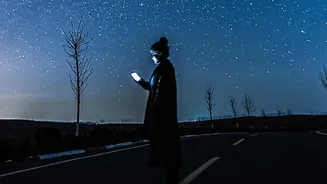
Why Use a Skywatching App?
The vastness of the cosmos can be intimidating. What is that bright light near the moon? Is it a star or a planet? Is that swiftly moving dot a satellite or the International Space Station (ISS)? In the past, answering these questions required star charts,
a compass, and a lot of patience. Today, powerful and intuitive mobile apps use your phone's GPS and compass to create a real-time map of the sky. By simply pointing your phone upwards, you can identify stars, planets, constellations, and even man-made objects like the ISS. This technology, known as augmented reality (AR), overlays information on your screen, making it incredibly simple for anyone to become an amateur astronomer.
Star Walk 2: The All-Rounder for Novices
Often recommended for beginners, Star Walk 2 offers a brilliant balance of user-friendly design and rich features. Its main screen is an interactive map that tracks your movement, showing you exactly what’s in the sky you're pointing at. The app excels at making astronomy accessible, with beautiful graphics for constellations and detailed 3D models of planets and other celestial bodies. Its "Time Machine" feature lets you see the sky at any point in the past or future, perfect for planning your viewing sessions. While the free version contains ads, it's highly functional for identifying planets, stars, and tracking satellites. The app can also send you notifications for significant astronomical events. It's available for both Android and iOS devices.
SkyView Lite: Point, Shoot, and Identify
SkyView Lite is perhaps the most intuitive app for a complete beginner. Its core function is simplicity itself: open the app, point your phone at the sky, and it will instantly identify stars, constellations, and planets. It also uses AR to overlay this information onto your camera's view, creating a seamless experience of looking 'through' your phone at an annotated sky. One of its best features for beginners is its ability to track and identify satellite fly-bys, including the ISS and the Hubble Space Telescope. The app is praised for not overwhelming users with too much information, showing primarily what is visible to the naked eye from a typical location, which makes it less cluttered than more advanced apps. The free version is robust and available on both major platforms.
Stellarium Mobile: For a Deeper Dive
For those who start with the basics and quickly want more, Stellarium is a fantastic next step. It began as a popular open-source desktop program known for its realistic sky simulations and has been adapted into a powerful mobile app. Even the free version has an extensive catalogue of stars, nebulae, galaxies, and more. Stellarium excels at showing a realistic sky, accurately simulating twilight, and displaying a vast number of stars. Like other apps, it can track satellites, including the ISS, and allows you to see the sky from any date, time, and location. Its interface is minimalist and easy to use, making it one of the best choices for both adults and children wanting to explore deeper.
NASA App & ISS Detector: Official and Specialised
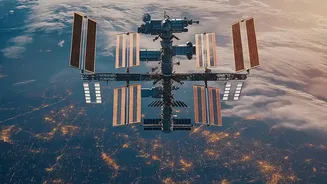
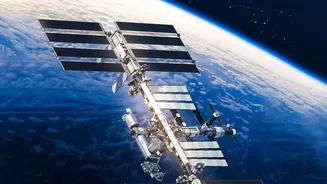
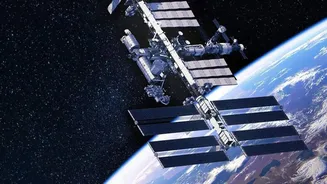
For those specifically fascinated by human space exploration, the official NASA app is a must-have. While not solely a stargazing app, it provides a wealth of information, live TV feeds, and, crucially, a reliable tracker for the International Space Station. For an even more focused experience, apps like ISS Detector are designed for one primary purpose: to tell you exactly when and where to look to see the ISS and other bright satellites. It provides pass predictions, alerts you before a flyover, and gives you a simple map to follow, ensuring you never miss the chance to wave at the astronauts overhead.
Bhagol: The Indian Sky Map
For a unique experience rooted in Indian astronomy, the Bhagol app offers a different perspective. Instead of the familiar Greek and Roman constellations, Bhagol displays the 27 nakshatras and the Rashi Chakra against the stars, using terminology from classical Indian texts like the Surya Siddhanta. It identifies the nine grahas, including Rahu and Ketu, and presents the sky as described in Indian astronomical traditions for millennia. The app even includes star names from over 50 South Asian languages. Pointing your phone at the sky with Bhagol allows you to connect with the cosmos through a rich, indigenous cultural lens.