
The Fragility of a Planet’s Breath
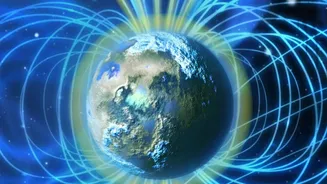
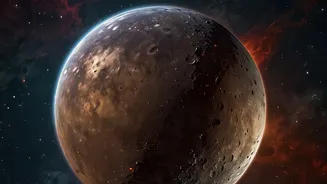
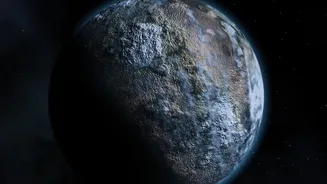
An atmosphere is a planet's life support system. It provides breathable air, shields against harmful radiation, traps heat to allow for liquid water, and protects the surface from meteorite impacts. Without a substantial atmosphere, a rocky world is just
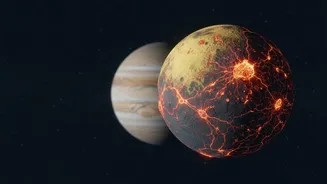
a barren rock in space. For a planet to be considered habitable in the long term, its ability to retain its atmosphere is just as important as its distance from its star. This is especially true for 'close-in' exoplanets, which orbit their stars so tightly that a 'year' can be just a handful of Earth days. These worlds are constantly blasted by intense stellar radiation and winds from their parent stars, putting their atmospheres at extreme risk.
Webb’s Extraordinary Vision
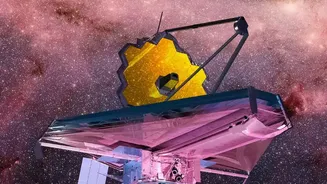
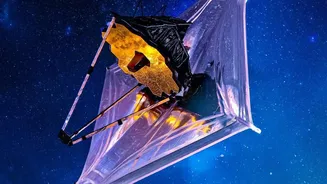
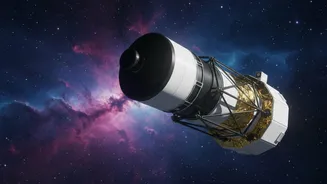
So how do you watch a planet lose its atmosphere from light-years away? The James Webb Space Telescope is uniquely equipped for this task. Using its powerful infrared spectrographs, JWST can analyse the tiny fraction of starlight that filters through an exoplanet's atmosphere as it passes in front of its star—an event called a transit. Different gases absorb light at specific wavelengths, leaving a unique chemical fingerprint. By studying these absorption lines, astronomers can identify the elements present in the atmosphere. To see an atmosphere actively escaping, they look for specific elements like helium, which is light and can be propelled far from the planet by the star's energy.
A 'Super-Puff' Planet's Ghostly Trail
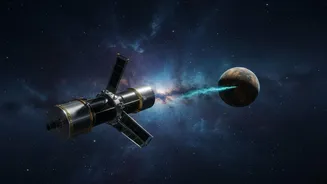
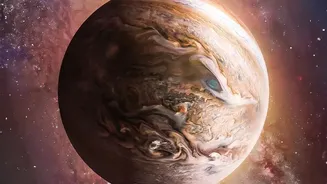
Recent observations have provided a stunning example of this process in action. JWST studied a 'super-puff' exoplanet named WASP-107b, a world nearly as large as Jupiter but with only a fraction of its mass. Because of its incredibly low density and its tight orbit—seven times closer to its star than Mercury is to our sun—WASP-107b is especially vulnerable to atmospheric stripping. Webb’s observations revealed a massive cloud of escaping helium gas. In a remarkable finding, this gas cloud was so extensive, stretching nearly ten times the planet's radius, that it was detected orbiting ahead of the planet itself. It was the most confident and detailed detection of atmospheric escape ever recorded, showing a planet's atmosphere being violently torn away in real-time.
Redefining the Habitable Zone
The traditional 'habitable zone' is defined as the orbital region around a star where a planet could possess liquid water on its surface. However, the work being done by JWST suggests this definition is too simple. A planet can be in the perfect temperature zone, but if its star's radiation has stripped away its atmosphere over millions of years, it cannot be habitable. This is particularly true for planets orbiting M-dwarf stars, the most common type in our galaxy. These stars are cooler, meaning their habitable zones are much closer, but they are also known for intense flare activity that can erode an atmosphere. By studying which planets lose their atmospheres and why, scientists are essentially drawing new, more realistic boundaries for where life could actually survive.
Why Studying Barren Worlds Matters
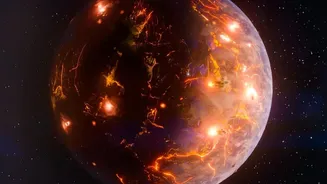
It may seem counterintuitive, but studying these inhospitable worlds that are losing their atmospheres is a critical step in finding a truly habitable one. Each observation of a planet like WASP-107b provides a crucial data point, helping scientists refine their models of planetary evolution. They are learning what types of planets, orbiting what types of stars, at what distances, are most likely to retain their atmospheres over billions of years. This process of elimination is vital. While recent studies of rocky worlds like TRAPPIST-1b and LHS 3844 b have found them to be bare rocks with no detectable atmosphere, this is not a failure. Instead, it is invaluable information that sharpens the focus of our search, guiding future observations toward the most promising candidates for a true Earth 2.0.