

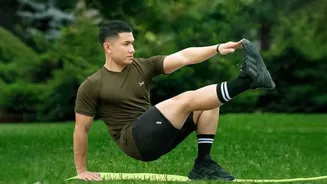

The Foundational Forearm Plank
The plank is a powerhouse of an exercise because it engages your entire core, including the deep transverse abdominis, rectus abdominis (the 'six-pack' muscles), and obliques. Unlike crunches, it strengthens your core without putting strain on your spine.
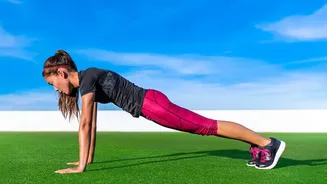
A strong core built with planks improves posture and stability. To perform a forearm plank, start by lying face down. Place your forearms on the floor with your elbows stacked directly under your shoulders. Extend your legs back, resting on your toes. Engage your core and glutes to form a straight line from your head to your heels. Avoid letting your hips sag or rise too high. Keep your gaze slightly ahead of your hands on the floor to maintain a neutral neck. Hold this position for 20-60 seconds, focusing on steady breathing.
Dynamic Bicycle Crunches
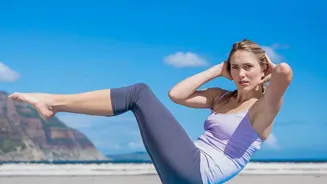
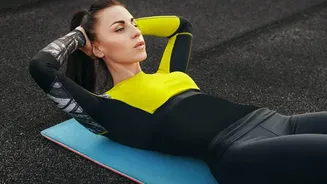
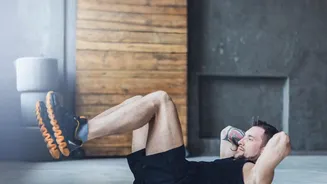
Bicycle crunches are a fantastic dynamic movement for targeting both the upper and lower abs as well as the obliques. The twisting motion is key to engaging the muscles along the sides of your waist. To begin, lie on your back with your hands placed lightly behind your head, elbows wide. Lift your knees to a tabletop position. Engage your abs to lift your head and shoulders off the floor. Now, begin the 'pedaling' motion: extend your right leg straight while twisting your upper body to bring your right elbow towards your left knee. Switch sides in a controlled manner, bringing your left elbow towards your right knee as you extend your left leg. The key is to move slowly and deliberately, avoiding pulling on your neck.
Lower Ab Targeting Leg Raises
Many common ab exercises neglect the lower part of the rectus abdominis. Lying leg raises are one of the best moves to specifically isolate and strengthen this area, along with your hip flexors. Lie flat on your back with your legs straight and together. You can place your hands under your lower back for support if needed. Keeping your legs as straight as possible, slowly raise them towards the ceiling until they are perpendicular to the floor. The crucial part of this movement is the descent. Lower your legs back down slowly and with control, stopping just before they touch the floor to keep tension on your abs. Exhale as you lift and inhale as you lower.
The Stabilising Bird-Dog
The Bird-Dog may look simple, but it's an incredibly effective exercise for enhancing core stability, balance, and coordination. It trains your core to remain stable while your limbs are in motion, which is essential for both athletic performance and everyday activities. It engages the deep core muscles, glutes, and spinal extensors without putting pressure on the back, making it great for all fitness levels. Start on all fours in a tabletop position, with your hands directly under your shoulders and your knees under your hips. Keeping your back flat and your core engaged, extend your right arm straight forward and your left leg straight back simultaneously. Your extended arm and leg should form a straight line with your torso. Hold for a moment, focusing on keeping your hips level, then return to the starting position with control. Repeat on the other side.
Rotational Russian Twists
To achieve a truly well-rounded core, you need to incorporate rotational movements. The bodyweight Russian twist is a classic exercise that specifically targets the obliques, the muscles responsible for twisting and side-bending motions. Sit on the floor with your knees bent and feet flat. Lean back slightly, keeping your spine straight, until you feel your abdominal muscles engage. For a greater challenge, lift your feet a few inches off the floor. Clasp your hands together in front of your chest. Slowly twist your torso from side to side, moving your hands towards the floor on each side. The rotation should come from your ribs, not just your arms. Focus on a controlled movement rather than speed.