


A Prime Target for Science
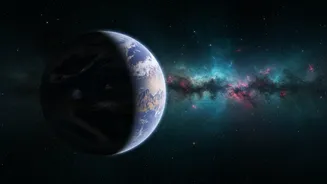
Located a mere 39 light-years from Earth, the TRAPPIST-1 system is a star discovery for astronomers. It features an ultracool red dwarf star, much smaller and dimmer than our sun, orbited by seven rocky, Earth-sized planets. What makes this system particularly
compelling is its layout. All seven planets orbit their star closer than Mercury orbits our sun, meaning they complete their years in a matter of Earth days. This compact arrangement, combined with the fact that several planets lie within the star's 'habitable zone'—where temperatures could potentially allow for liquid water—makes TRAPPIST-1 a perfect laboratory for studying worlds beyond our own.
The Technique: Transmission Spectroscopy
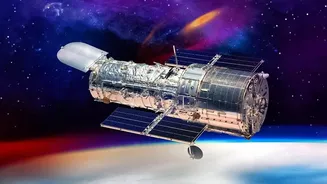
JWST can't see these planets directly; they are too small and too overwhelmed by the light of their parent star. Instead, it uses a clever technique called transmission spectroscopy. Imagine holding a coloured filter in front of a bright light. The filter absorbs some colours and lets others pass through. JWST does something similar. When a TRAPPIST-1 planet transits, or passes in front of its star from our perspective, a tiny sliver of starlight filters through the planet's atmosphere, if it has one. The molecules in that atmosphere absorb very specific wavelengths, or colours, of light. By capturing the starlight before, during, and after a transit, scientists can see which colours are missing. This creates a chemical 'barcode' that reveals the atmospheric composition.
Hunting for Carbon Clues
The molecules of greatest interest are often carbon-based, such as methane (CH4) and carbon dioxide (CO2). These are considered 'heavy' molecules in this context. On Earth, these gases are fundamental to our planet's climate and biology. Finding them in the atmosphere of a rocky exoplanet would be a monumental discovery, offering clues about its geology, climate, and potential habitability. An abundance of CO2 could suggest a planet with a thick, Venus-like atmosphere, while the presence of methane could hint at geological or even biological processes. These carbon-bearing molecules are key pieces of the puzzle in determining whether a distant world is a barren rock or a dynamic planet with complex systems.
What Webb Has Found So Far
Applying this technique to the TRAPPIST-1 planets is a delicate process. The signals are incredibly faint, and the star's own activity can interfere with the data. As of late 2025 and early 2026, JWST has observed several of the system's planets. For the innermost planets, TRAPPIST-1b and 1c, the telescope has found no significant evidence of an atmosphere, suggesting they may be bare rock. For TRAPPIST-1d, which is on the inner edge of the habitable zone, observations have ruled out a thick, Earth-like atmosphere, though a very thin one like Mars's or one obscured by high-altitude clouds remains a possibility. The most intriguing results have come from TRAPPIST-1e, a world right in the habitable zone. While data analysis is ongoing, scientists have ruled out a thick, hydrogen-dominated atmosphere. The current observations are not yet sensitive enough to definitively confirm or deny a thinner, nitrogen-based atmosphere, possibly with traces of methane, but every observation sharpens the picture.