






A Historic Moment in Delhi
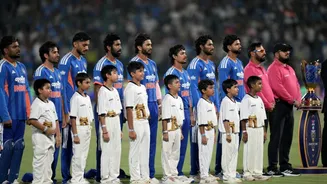
Before the first T20I between India and Afghanistan on September 13, 2026, a moment of historic significance unfolded at New Delhi's Arun Jaitley Stadium. As both teams lined up, the familiar routine of playing the national anthems was altered. Instead,
the proceedings began with a full rendition of 'Vande Mataram', India's national song. The complete version, lasting over three minutes, was played, followed by India's national anthem, 'Jana Gana Mana', and then the national anthem of Afghanistan. This marked the very first time that 'Vande Mataram' was officially played before the national anthem at an international cricket match involving the Indian men's team, catching many fans and observers by surprise.
The Official Reason: A New Government Protocol
The change was not a spontaneous decision or a mistake. It was the direct result of a new protocol implemented by the Indian government. Earlier in the year, the Union Ministry of Home Affairs issued formal guidelines on the rendition of the national song. These guidelines stipulated that whenever 'Vande Mataram' and the national anthem, 'Jana Gana Mana', are to be played together at an official function, the national song must be played or sung first. The event at the cricket match was an application of this directive. The Home Ministry's order also specified that audiences should stand at attention during the playing of the national song, just as they do for the national anthem, formalising its place in official ceremonies.
Celebrating a Milestone and New Legislation
The government's push to formalise the protocol for 'Vande Mataram' is linked to a major anniversary. The year marks the 150th anniversary of the national song, which was composed by Bankim Chandra Chattopadhyay in the 1870s. The new guidelines are part of a wider effort to commemorate this milestone and elevate the song's status. Further cementing its importance, the Indian Parliament in 2026 passed the Prevention of Insults to National Honour (Amendment) Act. This legislation, which received presidential assent in August, grants 'Vande Mataram' the same statutory protection as the national anthem. It makes intentionally preventing its singing or causing a disturbance during its rendition a punishable offence, thereby giving it equal legal sanctity in this regard.
A New Cricket Tradition for Home Series
This pre-match ceremony is set to become a new tradition in Indian cricket. According to sources within the Board of Control for Cricket in India (BCCI), the playing of 'Vande Mataram' before the national anthem will not be a one-off event. The plan is to incorporate this new protocol into the opening match of every international home series that India plays. This means fans can expect to see this sequence—national song followed by the two national anthems—as a regular feature when a new team tours India. While this was the first instance at a bilateral series, it remains to be seen if the practice will be adopted for major multi-team ICC tournaments held in the country.
Anthem vs. Song: Understanding the Difference
While both are revered national symbols, 'Jana Gana Mana' and 'Vande Mataram' have distinct official statuses. 'Jana Gana Mana' is India's National Anthem, as designated by the Constituent Assembly. 'Vande Mataram' is the National Song. The latter played a pivotal role during India's freedom struggle, serving as a powerful cry for independence. On January 24, 1950, Dr. Rajendra Prasad, the President of the Constituent Assembly, stated that 'Vande Mataram' would be honoured equally with the anthem. However, for decades, only the anthem had specific legal protections against insult. The recent government directives and the 2026 legal amendment aim to close that gap, elevating the formal status and protocol surrounding the National Song to be on par with the National Anthem in terms of respect and protection during public renditions.