








What Exactly Are Optical Skyrmions?
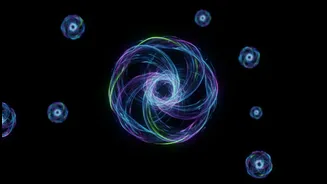
Imagine a smoke ring or a tiny, stable vortex in water. Now, picture that same concept but made of light. That’s the essence of an optical skyrmion. They are incredibly small, self-contained, and robust swirling patterns formed not by particles, but by the properties
of light itself, like its polarization and phase. Originally a concept from particle physics, skyrmions were later found in magnetic materials. Their stability is what makes them so special; they are 'topologically protected', meaning they don't easily unravel or fall apart, a bit like a well-tied knot. This resilience makes them a tantalizing prospect for encoding and storing information. Scientists believe these light-based 'knots' could become the building blocks for future technologies that need to be incredibly fast and small.
A Breakthrough from a Bygone Era
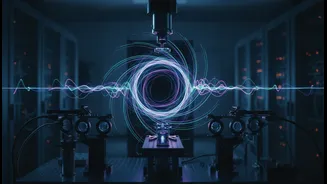
The most surprising part of this new research isn't just the creation of skyrmions, but how it was achieved. Instead of relying on expensive, artificially engineered 'metamaterials' which were previously required, researchers from Nanyang Technological University in Singapore used a much simpler setup. They pointed a laser at a small, circular disc. This simple act resurrected a 200-year-old phenomenon known as the "Poisson spot" or "Arago spot". This effect was central to a fierce debate in the 19th century about whether light was a particle or a wave. The wave theory predicted that a bright spot of light should appear directly in the middle of a circular object's shadow—a counterintuitive idea that was later proven correct and became a cornerstone of wave optics.
Connecting an Old Trick to New Tech
The Singaporean team realised that this historic bright spot was more than just a curiosity. Within that dot of light created by bending light waves around an object, the conditions were perfect for sculpting light's properties. The researchers found that the Poisson spot naturally created the complex, swirling configurations needed to form skyrmions. In fact, their method simultaneously produced four different types of optical skyrmions at once, related to light's spin, polarization, and electric and magnetic fields. This simplified approach dramatically lowers the barrier to entry for studying these exotic structures. It makes the generation of optical skyrmions more accessible and less costly, opening the door for more labs around the world to experiment with them.
The Promise of Light-Speed Data
So, why is the tech world excited about tiny light whirlpools? The applications are potentially transformative. Because optical skyrmions are so stable and small, they could be used to create ultra-high-density data storage. Imagine storing vast amounts of information in a space far smaller than today's hard drives. Furthermore, because they are made of light, they can be manipulated at incredible speeds, promising information processing and communication systems that are significantly faster and more energy-efficient than current electronics. This could lead to breakthroughs in everything from telecommunications and high-resolution imaging to quantum computing, where the stability of skyrmions could be used to protect fragile quantum information.
A Reality Check on the Horizon
While the potential is immense, it's crucial to remember the work is still in its early stages. Creating optical skyrmions in a controlled lab setting is a monumental first step, but it is a long way from a commercial product. Several significant hurdles remain. Researchers need to perfect the control of these light structures, learning how to write, read, and erase information reliably. Making them stable and operable at room temperature outside of specialised lab equipment is another major challenge. The journey from a fundamental physics discovery to a mass-produced technology is often decades long. This discovery has opened a new playground for physicists, but the games have just begun.