



Why Your Desk Job Hurts Your Back
When you spend hours sitting, often leaning forward to look at a screen, you're holding a static posture that your body isn't designed for. This causes the muscles in your upper back, like the trapezius and rhomboids, to become overstretched and fatigued
from constantly working to hold your head and arms up. At the same time, the muscles in your chest can become tight. This imbalance leads to stiffness, that burning sensation between your shoulder blades, and poor posture. The key is to introduce movement throughout the day to counteract this prolonged strain. Your best posture is always your next posture.
1. Seated Cat-Cow
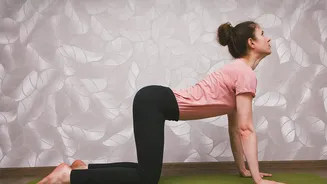
This classic yoga pose is adapted for your chair and is excellent for improving spinal mobility. Sit at the edge of your seat with your feet flat on the floor and hands on your knees. As you inhale, arch your back, push your chest forward, and look up toward the ceiling (Cow pose). As you exhale, round your spine, drop your chin to your chest, and let your shoulders and head fall forward (Cat pose). Move slowly between these two positions, coordinating with your breath. Repeat for 10-12 smooth cycles to gently wake up your spine.
2. Seated Thoracic Rotation
Prolonged sitting can make your mid-back (thoracic spine) incredibly stiff, and this move helps restore its natural ability to twist. Sit tall in your chair with your feet firm on the ground. Cross your arms over your chest, placing your hands on your opposite shoulders. Keeping your hips and legs still, slowly rotate your entire upper body to one side. Pause briefly at the end of your range of motion, then gently return to the center and rotate to the other side. Aim for 8-10 slow and controlled rotations on each side.
3. Shoulder Blade Squeezes
This simple move, also called scapular retraction, directly targets and strengthens the fatigued muscles between your shoulder blades that are responsible for good posture. Sit tall with your arms relaxed by your sides. Gently squeeze your shoulder blades together as if you are trying to hold a pencil between them. Be careful not to shrug your shoulders up toward your ears; keep them down and relaxed. Hold the squeeze for five seconds, then release. Repeat this 10 to 15 times to reset your posture and activate those key muscles.
4. Chin Tucks
Forward head posture, or 'text neck', is a major contributor to upper back strain. Chin tucks help correct this by strengthening the deep neck muscles. Sit or stand up straight, looking directly ahead. Without tilting your head up or down, gently draw your head straight back, as if you are making a double chin. You should feel a stretch at the base of your skull and an engagement of the muscles in the front of your neck. Hold for a few seconds and then relax. Perform a set of 10 repetitions periodically throughout the day.
5. Overhead Reach
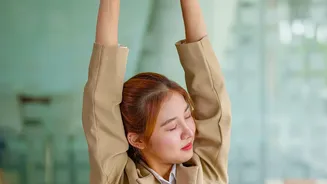
An overhead stretch helps lengthen the sides of your body and the muscles around your shoulders and upper back. Sit tall in your chair. Interlace your fingers and push your palms up toward the ceiling, straightening your arms as much as you can. Feel the stretch through your arms, shoulders, and upper back. For a deeper stretch, lean gently from side to side, holding each for a few breaths. This not only stretches the muscles but also encourages deep breathing, which can help relieve tension.
6. Cross-Body Shoulder Stretch
This stretch targets the posterior part of your shoulder and upper back muscles, which can hold a lot of tension. Bring your right arm across your body at shoulder height. Use your left arm to gently pull the right arm closer to your chest, deepening the stretch. You should feel it in the back of your right shoulder. Hold for 20-30 seconds, breathing normally, and then switch sides. Ensure you are not rotating your torso; the stretch should be isolated to the shoulder.
7. Thoracic Extension Over Chair
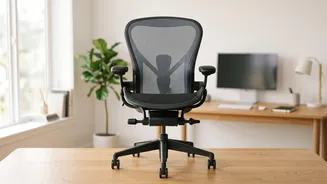
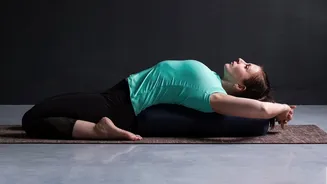
This is a great way to reverse the forward hunch that develops during the day. Sit forward in your chair so your upper back is aligned with the top of the chair back. Place your hands behind your head to support your neck. Now, gently lean back over the chair, allowing your chest to open and your upper back to arch. Breathe out as you extend. Don't force the movement, just allow gravity to help you open up your chest and counteract the slump. Hold for a few deep breaths and repeat 5-8 times.