


Beyond the Visible Spectrum
When we look at a galaxy through a standard telescope, we're seeing it in visible light, the same sliver of the electromagnetic spectrum our eyes are tuned to. But this is like trying to understand a symphony by hearing only the violins. The cosmos is bursting
with information carried on other wavelengths. Different physical processes emit different kinds of light; cooler, lower-energy phenomena show up in longer wavelengths like infrared and radio, while extremely hot, violent events blaze in high-energy X-rays and gamma rays. To get the full picture of a galaxy—its past, present, and future—astronomers need to become fluent in all these languages of light. This practice, known as multiwavelength astronomy, involves combining data from various specialized telescopes, both on the ground and in space.
The Radio View: Cosmic Fuel and Giant Jets
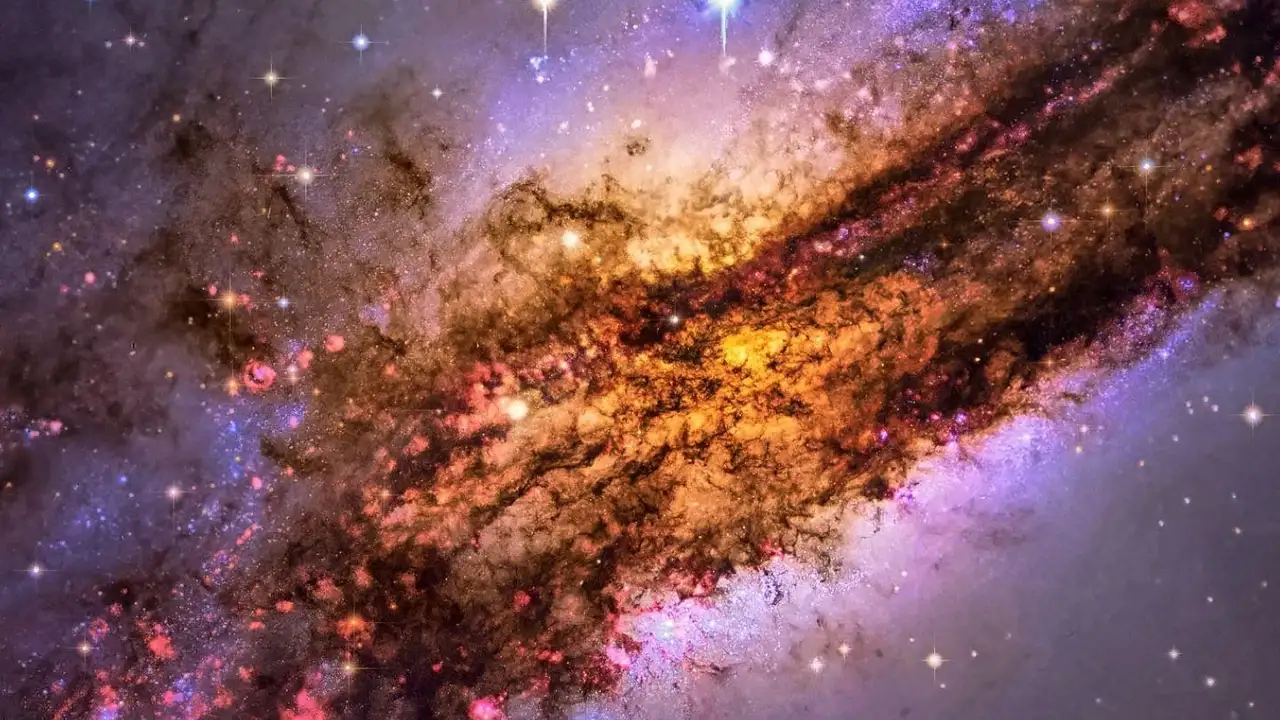
Viewing a galaxy in radio waves is like putting on a pair of glasses that filters out the stars and instead shows the raw ingredients and dramatic outflows. Radio telescopes detect the cold hydrogen gas that serves as the fundamental fuel for future star formation. They also reveal spectacular phenomena that are completely invisible otherwise. A fantastic example is the galaxy Centaurus A. In visible light, it looks like a large elliptical galaxy with a dark slash of dust across its middle. But in the radio spectrum, we see two colossal jets of material blasting out from the supermassive black hole at its center, extending for over a million light-years into space. These jets, powered by the black hole's immense gravity, are a testament to the galaxy's violent core activity.
The Infrared View: Piercing the Veil of Dust
Where visible light is blocked by cosmic dust, infrared light shines through. Telescopes like the James Webb Space Telescope are designed to see in the infrared, allowing them to peer into the dusty heart of galaxies. In the case of Centaurus A, the dark, obscuring dust lane that dominates its visible-light image becomes a brightly glowing band in the infrared. This glow comes from the warmth of countless young stars being born inside these dense clouds. Infrared astronomy is therefore crucial for understanding star formation. It reveals the stellar nurseries hidden from our view, showing us where the next generation of stars is lighting up, a process that is fundamental to a galaxy's evolution.
The X-Ray View: Unmasking Extreme Violence
If you want to find the most extreme environments in a galaxy, you look for X-rays. This high-energy light is produced by matter heated to millions of degrees, often by cataclysmic events. Space-based X-ray observatories like NASA's Chandra X-ray Observatory give us a front-row seat to this cosmic violence. Looking at Centaurus A in X-rays reveals several key features. We can see the jets emanating from the central black hole, as well as the points where these jets crash into surrounding gas, creating shockwaves. X-ray data also helps astronomers pinpoint the locations of other high-energy objects like neutron stars and smaller black holes scattered throughout the galaxy. It’s a view of the galaxy at its most powerful and turbulent.
Assembling the Cosmic Puzzle
No single wavelength tells the whole story. The true power of multiwavelength astronomy comes from combining these different views into a single, comprehensive picture. When astronomers layer the radio, infrared, visible, and X-ray images of a galaxy like Centaurus A, a complete narrative emerges. They can see the reservoir of cold gas (radio) that feeds the star-forming nurseries (infrared), which are embedded within the galaxy's main stellar structure (visible), all while being shaped by the violent outflows from the central supermassive black hole (X-ray and radio). It’s a holistic approach that allows scientists to connect the dots between a galaxy's various components and understand it as a single, dynamic ecosystem, from its calmest regions to its most violent heart.