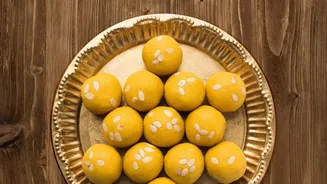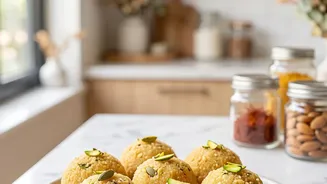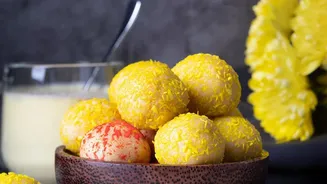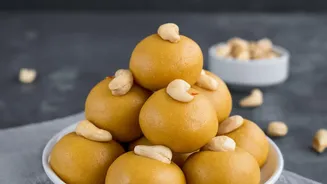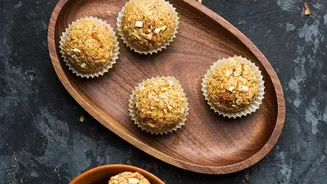



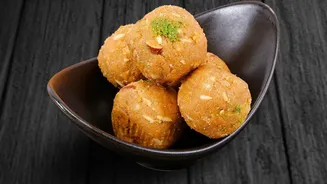
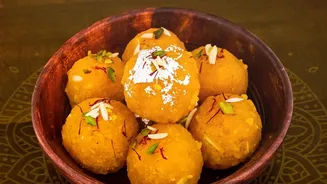
The perfect besan ladoo is a thing of beauty: a golden sphere that melts in your mouth. But achieving that ideal softness can be tricky. The secret isn't just in the recipe, but in understanding the role of its most crucial ingredient: ghee.
More Than Just a Fat
Ghee is the
soul of many Indian sweets, and for besan ladoo, it's non-negotiable. It's far more than just a cooking medium; it’s a flavour enhancer, a binding agent, and the primary driver of texture. Unlike neutral oils, ghee has a high smoke point and a distinct nutty, caramelised aroma that blossoms when heated. This flavour infuses the besan (gram flour) during the roasting process, creating the rich, comforting taste that defines a good ladoo. Without it, the ladoo would taste flat and raw.
The Science of a Soft Bite
The magic of ghee lies in how it interacts with the besan. As you roast the flour, the fat in the ghee coats each individual particle. This coating serves two purposes. Firstly, it ensures the besan cooks evenly without clumping or burning, which is critical for a smooth finish. Secondly, this fat layer is what delivers the melt-in-the-mouth sensation. It creates a tender, almost crumbly structure that dissolves on the tongue, rather than a dense or pasty one. Using too little ghee will leave you with a dry, crumbly mixture that refuses to hold its shape, while too much results in a greasy ladoo that slumps and won't bind properly.
The Roasting Process is Key
Patience during the roasting stage, or 'bhuno,' is where the texture is truly built. This step should be done on a low and slow flame, stirring continuously. In the beginning, the besan and ghee mixture will be thick and pasty. As you continue to roast, the besan cooks, releases moisture, and absorbs the fat, causing the mixture to loosen and become more fragrant and liquid-like. This process can take anywhere from 20 to 45 minutes, depending on the quantity. Rushing this with high heat will result in a raw, beany taste or, worse, burnt, bitter flour. The goal is a nutty aroma and a uniform golden-brown colour.
Finding the Perfect Ratio
The ideal ratio of ghee to besan is a subject of much kitchen wisdom. By weight, a good starting point for classic, soft ladoos is roughly 1 part ghee to 2 parts besan. For instance, for 200g of besan, around 100g–120g of ghee is typical. Using coarse besan, often sold as 'ladoo besan', can also help achieve a more desirable grainy texture, as fine besan can sometimes become dense. If you only have fine besan, some recipes suggest adding a tablespoon of semolina (sooji) to mimic that granular bite. The key is to add ghee gradually, as different flours have different absorption rates.
Temperature and Timing for Sugar
One of the most common mistakes that leads to hard, crystalline ladoos is adding sugar to the besan mixture while it's still hot. Hot ghee will melt the powdered sugar, turning it into a syrup. As this syrup cools, it recrystallises, making the ladoos hard or brittle instead of soft. To avoid this, you must let the roasted besan–ghee mixture cool down until it is just warm to the touch before stirring in the sugar. This ensures the sugar crystals remain suspended in the fat, contributing to that perfect, slightly grainy, and tender texture every ladoo–lover craves.