


Meet the Cigar Galaxy
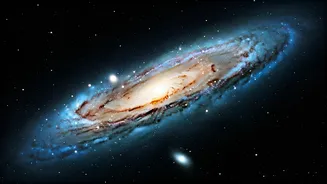
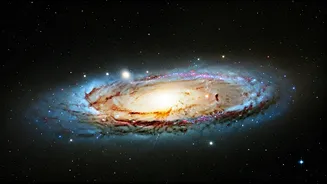
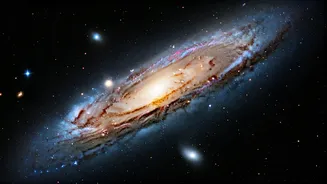
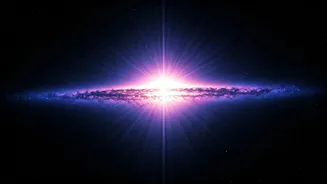
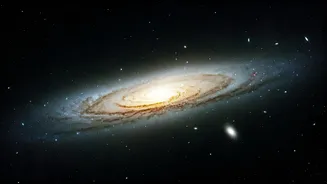
Messier 82, nicknamed the Cigar Galaxy for its elongated shape from our viewpoint, isn't your average spiral. Located in the Ursa Major constellation, it's what astronomers call a 'starburst' galaxy. This means it's forming new stars at a blistering pace—about
ten times faster than in our own Milky Way. This intense activity, likely triggered by a past gravitational encounter with a neighbouring galaxy, makes M82 a perfect laboratory for studying how stars are born under extreme conditions and how this explosive growth shapes a galaxy's evolution. However, the very dust that fuels this star formation also acts like a thick veil, hiding the galaxy's core from the view of many telescopes.
Webb’s Unprecedented View
Enter the James Webb Space Telescope (JWST). With its powerful infrared vision, Webb can pierce through cosmic dust clouds that are opaque to other observatories like Hubble. In a recent, detailed survey, a team of astronomers pointed Webb’s Near-Infrared Camera (NIRCam) at M82’s core. The result was an image of stunning clarity, resolving about 16.5 million individual stars for the first time and revealing the galaxy’s structure in never-before-seen detail. As one lead investigator, Adam Smercina, put it, “M82 is a mess, but it's a beautiful mess.” The new data provides what he calls a “full lab setup” to understand the galaxy's complex processes.
Tracing the Galactic Superwind
One of the most dramatic features of M82 is the colossal outflow of material being blasted from its center, a phenomenon known as a 'galactic superwind'. The combined energy from countless young, massive stars and subsequent supernova explosions drives this wind, pushing gas and dust out of the galaxy. Webb’s new observations have mapped this wind with incredible precision by tracing the glow of specific molecules called polycyclic aromatic hydrocarbons, or PAHs. These molecules, seen as intricate red filaments in the Webb images, trace the shape and structure of the wind, showing it gushing out from the galaxy's disk in a distinctive hourglass shape.
The 'Soot' of the Cosmos
So, what are these PAHs that are painting a picture of cosmic winds? Essentially, they are large, sturdy organic molecules made of carbon and hydrogen—think of them as a form of cosmic soot. On Earth, they are common byproducts of incomplete combustion, found in everything from engine exhaust to burnt toast. In space, they are incredibly abundant, potentially accounting for up to 20% of all carbon in the universe. They are believed to form in the outflows of stars and are tough enough to survive the harsh environment of interstellar space. By tracing these molecules, astronomers can track how the chemical ingredients for future stars and planets are spread throughout and between galaxies.
Why This Changes Things
This detailed look at M82's superwind is more than just a pretty picture; it delivers on the headline's promise of 'big science energy'. By seeing how PAHs are distributed within the outflow, scientists can better understand the physics of how galactic winds are launched. Unexpectedly, Webb found that the structure of the PAH emission closely mimics that of hot, ionized gas. This suggests a complex interplay where PAHs may be getting destroyed in the hottest parts of the wind but are continuously replenished from cooler clouds of gas that get swept up. This process is fundamental to galaxy evolution, as it regulates star formation by ejecting the very gas needed to form new stars, while also enriching the space around the galaxy with heavy elements. Webb’s findings provide crucial, granular data to refine our theories about this cosmic feedback loop.