




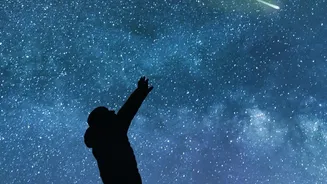

What Are the Orionids?
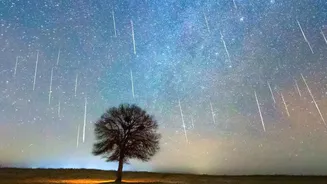
The Orionid meteor shower happens annually when Earth passes through the dusty debris trail left behind by Halley's Comet. As these tiny fragments, often no bigger than a grain of sand, enter our atmosphere at incredible speeds—about 66 kilometres per
second—they burn up, creating the brilliant streaks of light we call 'shooting stars'. These meteors are known for their brightness and speed, and can sometimes leave glowing 'trains' that linger for a few seconds. The shower gets its name because the meteors appear to radiate from a point in the constellation Orion, but you don't need to look directly at Orion to see them; they will be visible across the entire night sky.
When and How to Watch in 2026
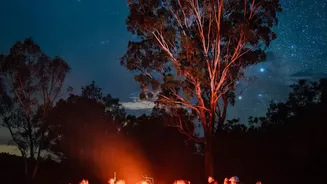
The Orionids are active from early October to early November, but the peak for 2026 is expected on the night of October 21-22. Under perfect conditions, you might see 15 to 25 meteors per hour. However, there is a challenge this year: a bright waxing gibbous Moon will be in the sky for much of the night, washing out the fainter meteors. For viewers in India, the best strategy is to wait until the pre-dawn hours, after the Moon sets around 3 a.m. but before sunrise. Find a dark spot away from city lights, lie back on a blanket or reclining chair, and let your eyes adjust for at least 30 minutes. No special equipment is needed; your unaided eyes are your best tool for this celestial show.
Hanle, Ladakh: India's Dark Sky Capital
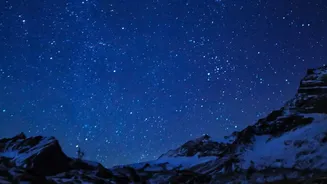
For the ultimate stargazing experience, nowhere in India beats Hanle. Located in a remote part of Ladakh, it is officially designated as India's first Dark Sky Reserve, meaning artificial light is heavily restricted to protect the pristine night skies. At an altitude of over 14,000 feet, the air is thin, dry, and clear, offering breathtaking views of the cosmos. Hanle is home to the Indian Astronomical Observatory, one of the highest in the world, a testament to the area's world-class viewing conditions. Here, the Milky Way is often visible to the naked eye, and a meteor shower becomes a truly immersive experience. Remember to obtain an Inner Line Permit before travelling to this protected region.
Spiti Valley, Himachal Pradesh: A High-Altitude Desert
Like Ladakh, Spiti Valley is a high-altitude cold desert that offers some of the darkest skies in the country. Its remote location, high elevation, and rain-shadow geography mean the skies are exceptionally clear, especially from May to October. Villages like Kibber, Langza, and Komic are prime spots for stargazing, situated far from any significant light pollution. The landscape itself, with its stark mountains and wide-open valleys, provides a dramatic backdrop for the celestial display. Just a short drive from the main towns of Kaza or Tabo can lead you to a perfect, dark patch of sky. As temperatures drop sharply at night, even in summer, be sure to pack warm layers.
Rann of Kutch, Gujarat: A Salt Desert Spectacle
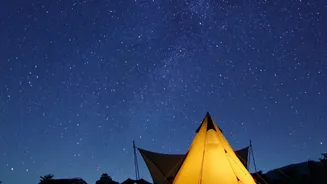
The Great Rann of Kutch offers a unique and surreal setting for watching a meteor shower. The vast, flat expanse of the white salt desert provides an uninterrupted 180-degree view of the sky. With very little light pollution, especially away from the main Rann Utsav tent city, the stars shine with remarkable clarity. The best time for stargazing here is during the winter months, from November to February, when the air is dry and clear. While the Orionids peak in October, the shower is still active into early November, overlapping with the start of the Rann Utsav season. Imagine lying on the cool salt flats as meteors streak across the vast desert sky—a truly memorable experience.
Other Promising Locations
While the Himalayan deserts offer unparalleled clarity, you don't necessarily need to travel to such extreme locations. Coorg in Karnataka, away from the town centres, offers dark skies thanks to its coffee plantations and hilly terrain. In Rajasthan, the desert camps near Jaisalmer and the ghost village of Kuldhara provide accessible and dark viewing spots. Even hill stations in Uttarakhand like Kausani can offer a great view if you find a location shielded from local lights. The key is to get as far away from urban light pollution as possible, find a clear, open view of the sky, and give yourself time to simply watch and wait.