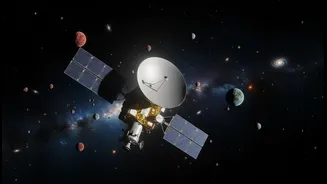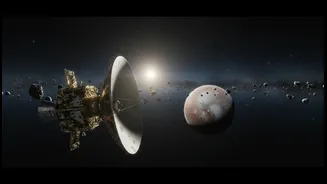







From Pluto to the Unknown
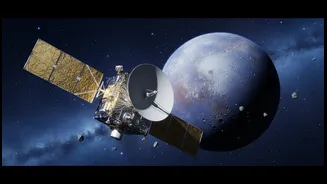
It feels like a lifetime ago, but in 2015, New Horizons fundamentally changed our view of the outer solar system. It transformed Pluto from a fuzzy pixel into a dynamic world with vast nitrogen glaciers, towering water-ice mountains, and hints of a subsurface
ocean. The mission was a stunning success, delivering 5,000 times more data on Pluto than the Mariner probes did for Mars decades earlier. But that was just the beginning. In 2019, it performed the most distant flyby in history, visiting Arrokoth, a snowman-shaped object in the Kuiper Belt. This encounter provided an unprecedented look at a primordial planetesimal, a building block of planets, sending scientists back to the drawing board on planetary formation.
An Old Probe's New Tricks
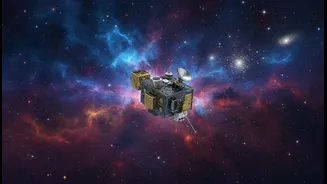
Launched in 2006, New Horizons is now a seasoned explorer. Like the legendary Voyager probes that came before it, it faces the challenges of immense distance and dwindling power. Radio signals take nearly nine hours to travel from the spacecraft to Earth. To conserve energy for its long journey through the Kuiper Belt, mission operators routinely place it into long periods of hibernation. After its most recent, 321-day nap, it woke up in good health in mid-2026, ready for its next chapter. This phase of its life isn't about dramatic flybys, but about persistence. The probe has enough fuel for another potential encounter if a suitable target is found, but its true value now lies in its unique location.
The Science of the Outer Dark
Even as it cruises, New Horizons is a vital scientific platform. It is one of only a handful of spacecraft to ever operate in the Kuiper Belt, the vast donut-shaped ring of icy bodies beyond Neptune. While it sleeps, its instruments continue to measure the charged particles of the solar wind and the density of dust in this little-explored region. This heliophysics data is crucial for understanding the boundary where the Sun's influence ends and interstellar space begins. Its observations have already suggested the Kuiper Belt may be far larger than previously thought and have confirmed the existence of a 'hydrogen wall' at the solar system's edge. These quiet, long-term measurements provide a unique dataset that helps map the very structure of our cosmic neighbourhood.
A Blueprint for Frugal Exploration
Perhaps the most significant legacy of New Horizons' extended mission is the lesson it provides for the future of space exploration. Operating a complex spacecraft billions of miles away on a limited power budget is forcing NASA to innovate. The strategies developed to manage its systems, prioritize data, and eke out every last drop of scientific potential are creating a new blueprint for what ageing probes can accomplish. As NASA plans for even more ambitious missions into deep space, the experience with New Horizons demonstrates the immense return on investment from extending the lives of proven, healthy spacecraft. It proves that a mission's value doesn't end after its primary objectives are met. Instead, these probes can transform into long-term observatories, providing decades of data for a fraction of the cost of launching a new mission.