
The Cosmic Shadow Play
Imagine a moth flying in front of a bright lamp. From a distance, you can’t see the moth itself, but you notice a tiny, brief dip in the lamp’s brightness. Astronomers use this same principle to find and study exoplanets, which are planets orbiting stars
other than our Sun. This event is called a 'transit'. When a planet’s orbit is perfectly aligned from our viewpoint, it passes directly in front of its star, causing a periodic and predictable dip in starlight. By measuring how much the star dims, scientists can calculate the planet’s size. This transit method is how thousands of exoplanets have been discovered, but its real power lies in what happens at the planet's edge.
Starlight's Chemical Barcode
As a planet transits, a very thin ring of its atmosphere is backlit by the star. A tiny fraction of the starlight filters through this atmospheric layer before continuing its journey to our telescopes. This is where the magic of spectroscopy comes in. Think of it like shining a white light through a coloured filter; the filter absorbs some colours and lets others pass. A planet's atmosphere does the same thing. Each gas—like oxygen, methane, or water vapour—absorbs very specific wavelengths, or colours, of light. This process imprints a unique pattern of missing colours onto the starlight, creating a sort of chemical 'barcode' or fingerprint. By analysing this barcode, scientists can identify the gases present in that distant world’s air.
The Telescope’s Delicate Task
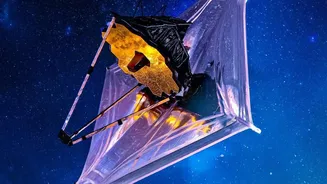
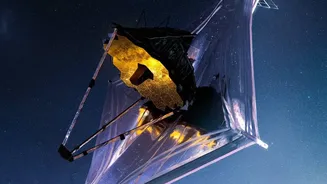
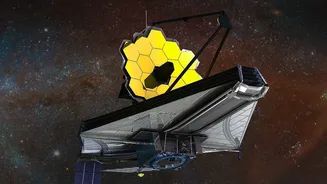
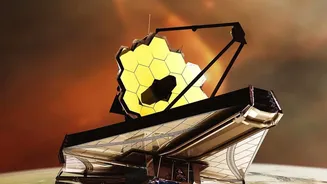
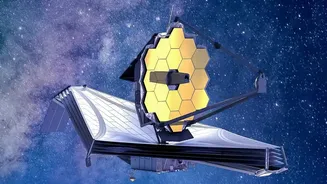
Detecting this faint atmospheric signal is an immense technological challenge. The light filtering through the atmosphere is an incredibly small portion of the total starlight, and the changes are minuscule. This is a job for powerful space telescopes like the James Webb Space Telescope (JWST), which are positioned beyond Earth's own atmosphere to get a clear view. To isolate the planet's atmospheric signature, astronomers measure the star's light spectrum just before the transit, during the transit, and after. By subtracting the 'during' spectrum from the 'before' spectrum, they can effectively remove the star’s own light and be left with only the absorption lines created by the planet's atmosphere. This resulting graph, called a transmission spectrum, shows exactly which wavelengths of light were absorbed.
Decoding the Signs of Life
The ultimate goal of analysing these atmospheric barcodes is the search for biosignatures—gases or combinations of gases that could indicate the presence of life. On Earth, life produces an atmosphere rich in oxygen, with traces of methane. Finding both of these gases together on a rocky exoplanet could be a compelling sign of biological processes, as they tend to destroy each other without a constant source. Scientists look for key molecules like oxygen, ozone, water vapour, and carbon dioxide. However, interpreting these findings is complex. Many of these gases can also be produced by non-biological, or abiotic, processes like volcanic activity or chemical reactions triggered by starlight. Therefore, context is everything; scientists must consider the type of star, the planet's temperature, and other factors before drawing conclusions.
Challenges and the Future
Transit spectroscopy is an extraordinary tool, but it has limitations. The atmospheric signal from smaller, rocky planets is exceptionally weak and can be hard to distinguish from instrumental noise. Clouds and haze can also obscure the view, flattening the spectrum and hiding the chemical signatures beneath them. Furthermore, the method only works for planetary systems that are aligned edge-on to us, which is a small fraction of the total. Despite these hurdles, the technology is rapidly advancing. The James Webb Space Telescope has already provided unprecedented insights into exoplanet atmospheres, detecting carbon dioxide, water, and swirling silicate clouds. Future observatories are being designed with even greater sensitivity, promising to push us closer to answering whether we are alone in the universe.