





A New Cosmic Detective Tool
Imagine trying to piece together the history of a person by only analyzing the air they exhale. It sounds like science fiction, but that’s precisely what astronomers are now doing with planets hundreds of light-years away. Recent studies, powered by the capabilities
of instruments like the James Webb Space Telescope, have successfully detected methane in the atmospheres of a strange class of exoplanets. This isn't just about finding another chemical; it's about unlocking a new method to answer one of the biggest questions in planetary science: do planets stay where they are born, or do they wander? Methane, it turns out, acts as a chemical breadcrumb, allowing scientists to follow a planet's orbital path through time.
The Curious Case of Warm Neptunes
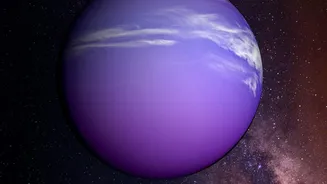
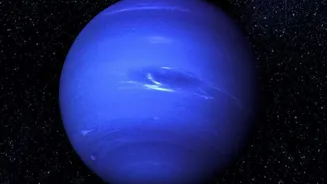
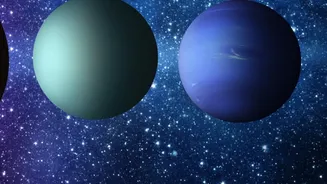
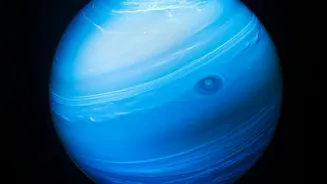
The planets at the heart of this discovery are known as “warm Neptunes.” These are worlds similar in size to our own Neptune or Uranus, but they orbit much closer to their stars, making them significantly hotter. There's nothing like them in our own solar system, which makes them cosmic oddballs and perfect natural laboratories. Their proximity to their star means they complete an orbit in mere days or weeks, making them easier to spot and study using the transit method—where astronomers watch for the slight dimming of a star as a planet passes in front of it. The existence of these warm Neptunes so close to their stellar furnaces has long been a puzzle. Theory suggests that planets of this size shouldn't form so close in, where the building blocks of planets are scarce.
Methane as a Planetary Fingerprint
So how does methane solve this puzzle? The answer lies in planetary formation. A planet's atmosphere is largely inherited from the material in the protoplanetary disk from which it formed. The chemical composition of that disk changes with distance from the central star. In the cold, distant outer regions of a solar system—beyond what’s called the “ice line“—-molecules like methane and water are frozen solid and plentiful. Closer to the star, it's too hot for these ices to exist. Therefore, a planet’s atmospheric chemistry, specifically its ratio of elements like carbon and oxygen, can serve as a fingerprint of its birthplace. A high abundance of water or methane strongly suggests the planet formed in the frosty outer reaches of its system.
Connecting Chemistry to Grand Journeys
This is where the headline comes to life. By mapping the methane in a warm Neptune’s atmosphere, astronomers can test the theory of planetary migration. If a warm Neptune has very little methane in its atmosphere, it might suggest it formed in its current, hot location. However, if astronomers detect significant amounts of methane—a carbon-rich molecule—it's compelling evidence that the planet couldn't have formed there. Instead, it must have been born in the cold outer system and then embarked on a grand inward journey over millions of years, a process known as planetary migration. The atmospheric data from planets like WASP-80 b and TOI-1130 b provides some of the clearest evidence to date that planets can and do move from their birthplaces.
Unlocking the Secrets of Our Past
While this research focuses on distant worlds, its implications are profound for understanding our own cosmic home. The architecture of our solar system, with small rocky planets near the Sun and gas giants far out, is just one possible outcome of planetary formation. Scientists have long debated the extent to which our own giant planets, like Jupiter and Neptune, may have migrated in the early days of the solar system. By studying these processes in other systems, we gain invaluable context. Each exoplanet with a mapped atmosphere is another data point, helping us build and refine the story of how planetary systems, including our own, come to be. It’s an “apples-to-apples” comparison that was impossible until now, allowing us to see if the rules that built our solar system are universal.