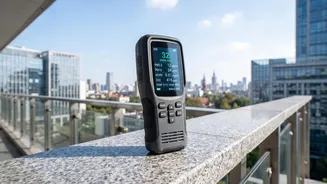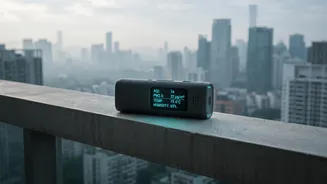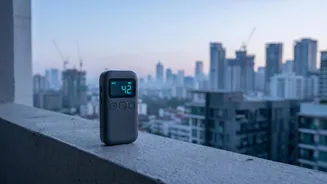







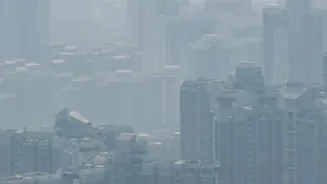
The hazy shroud of smog over Indian cities is a familiar sight, but what if you could know the precise air quality inside your own housing society, right now? A new wave of technology is making that possible, empowering communities to act.
Beyond City-Wide Averages
For years, our
understanding of air pollution has been shaped by data from large, government-run monitoring stations. While essential, these stations provide a broad overview of a city's air quality, which can be very different from the 'hyperlocal' conditions in your specific neighbourhood or apartment complex. Factors like traffic density, nearby construction, or even celebratory fireworks can create pockets of severe pollution that city-wide averages miss. Residential air quality monitors are small, cost-effective devices installed directly within a community to provide real-time, localised data, offering a true picture of the air residents are actually breathing. This shifts the focus from a regional problem to a personal, manageable one.
How The Technology Works
So, how do these compact boxes measure invisible threats? Most modern air quality monitors use a method called laser scattering to detect particulate matter (PM). A small fan draws air into a chamber where a laser beam is projected. When tiny particles like PM2.5 and PM10—pollutants notorious for penetrating deep into the lungs—pass through the beam, they scatter the light. A photodetector measures this scattered light, and an internal algorithm calculates the concentration and size of these particles in real-time. Many devices also include electrochemical sensors to detect harmful gases like carbon monoxide (CO) and volatile organic compounds (VOCs). This data is then instantly processed and made available.
From Raw Data to Actionable Alerts
A stream of numbers is useless without context. The real innovation lies in how this data is delivered. These IoT-enabled devices connect wirelessly to the cloud. The information is then transmitted to a central dashboard or a user-friendly mobile app accessible to all residents in the complex. This system translates complex measurements into a simple, often colour-coded Air Quality Index (AQI), similar to the one used by government agencies. This means anyone can glance at their phone and know if the air outside is 'Good', 'Moderate', or 'Unhealthy'. Many systems can also be programmed to send automated alerts to the community when pollution levels exceed a safe threshold, providing timely warnings.
Empowering Residents and Building Managers
For residents, this immediate data empowers them to make informed health decisions. Parents can decide whether it's safe for their children to play outdoors, and individuals with respiratory conditions like asthma can take precautions. It provides peace of mind and a sense of control over one's environment. For Resident Welfare Associations (RWAs) and building managers, the benefits are operational. The data can be integrated with the building's management system to automate functions, such as increasing ventilation or activating central air purification systems when outdoor air is poor. This not only protects resident health but also optimises energy consumption by avoiding unnecessary ventilation. It also serves as a valuable amenity, demonstrating a commitment to resident well being and potentially increasing property value.