


It's a Dance, Not a Demolition
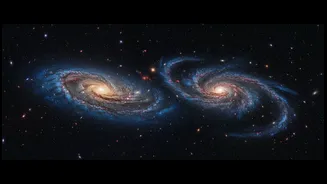
The first thing to understand about galaxy collisions is that they are not like car crashes. Galaxies are overwhelmingly made of empty space. While a galaxy like our Milky Way contains hundreds of billions of stars, the distances between them are astronomical.
To put it in perspective, if the Sun were the size of a ping-pong ball, the nearest star, Proxima Centauri, would be a pea about 1,100 kilometres away. Because of these vast distances, when two galaxies merge, their individual stars almost never hit each other. Instead, they pass by like ships in the night. The real action in a galactic merger is driven by the invisible force of gravity, which orchestrates a mesmerising dance that unfolds over hundreds of millions of years.
The Gravitational Tango Begins
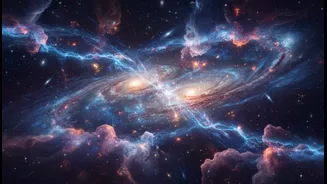
Everything starts with gravity. When two galaxies are close enough, their mutual gravitational attraction begins to pull them together. As they draw nearer, a process that can take millions of years, they begin to distort each other's shapes. Astronomers refer to these stretching forces as galactic tides. Much like the Moon's gravity pulls on Earth's oceans to create tides, the immense gravity of one galaxy pulls more strongly on the near side of its partner than on the far side. This differential pull starts to stretch and warp the galaxies' once-orderly structures.
Creating Tidal Tails and Starbursts
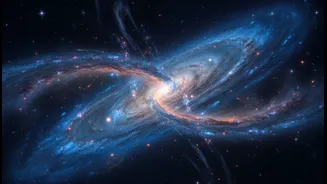
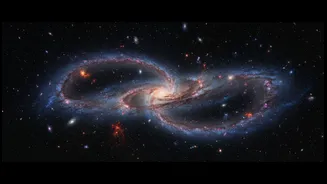
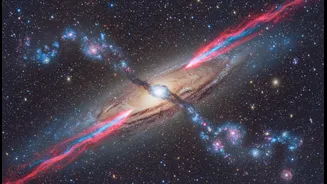
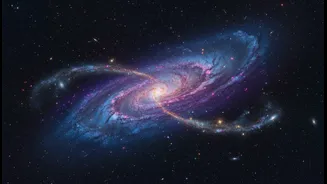
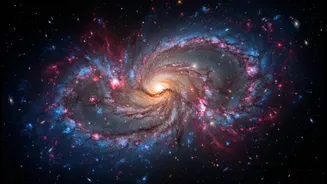
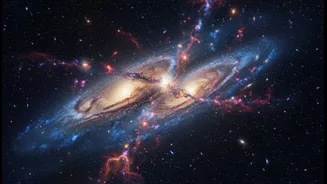
As the galaxies swing past each other, the gravitational tug-of-war flings out long, spectacular streamers of stars and gas. These are called "tidal tails," and they are a signature feature of interacting galaxies, painting glowing arcs across the cosmos. Famous examples like the Antennae and Mice galaxies showcase these beautiful, chaotic structures. But the collision does more than just rearrange stars; it sparks new life. The gravitational forces compress huge clouds of interstellar gas and dust within the galaxies. This compression triggers a massive wave of star formation, known as a "starburst." These regions light up with the brilliant blue glow of hot, young stars, making merging galaxies some of the most vibrant nurseries in the universe.
The Black Hole Ballet
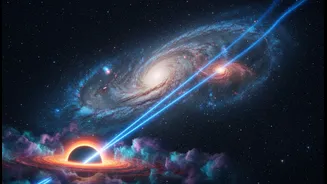
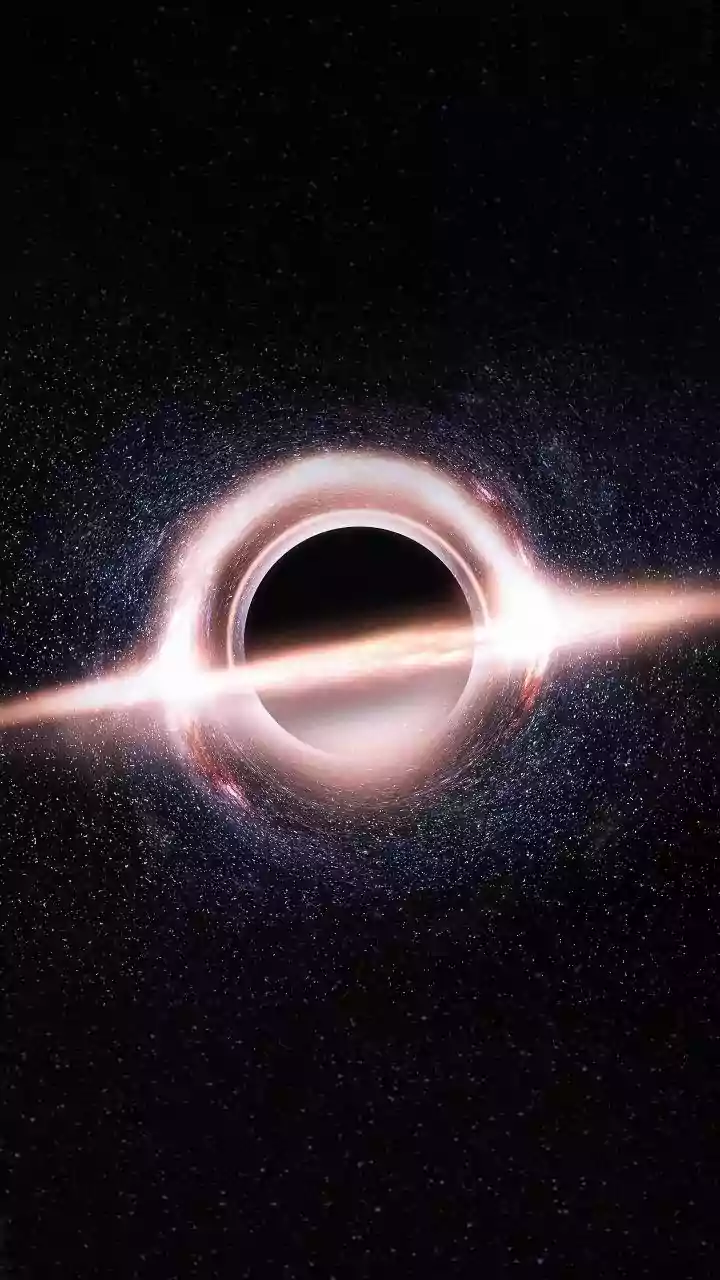
At the heart of most large galaxies, including our own Milky Way, lies a supermassive black hole. When galaxies merge, these cosmic behemoths are also set on a collision course. As their parent galaxies dance and intertwine, the black holes sink toward the centre of the newly forming galaxy. They begin to orbit each other in a final, tightening spiral. This cosmic ballet can take millions of years, but eventually, the two supermassive black holes will merge into one even larger black hole, releasing an immense burst of energy in the form of gravitational waves. This merger can sometimes fuel a brilliant quasar, briefly making the galaxy's core outshine all of its stars combined.
A New Galaxy Is Born
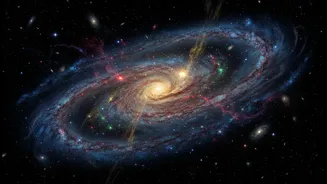
After hundreds of millions of years of chaotic interaction, the dance finally subsides. The two separate galaxies will have merged into a single, larger galaxy. Often, two beautiful spiral galaxies, like our Milky Way and Andromeda, will combine to form a large, less structured "elliptical" galaxy. The once-orderly rotational motion of the stars is replaced by more random orbits, a process called "violent relaxation." The spectacular tidal tails may remain for billions of years as a faint memory of the galaxy's dramatic past. In the end, what was once a violent collision results in the formation of a new, stable, and often more massive stellar system.
Our Own Cosmic Collision
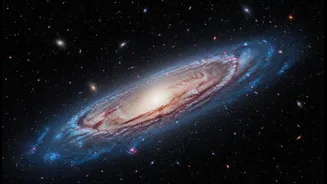
This cosmic story is not just something that happens to distant galaxies; it is the future of our own Milky Way. We are currently on a collision course with our nearest large neighbour, the Andromeda Galaxy. Hurtling towards each other at about 110 kilometres per second, the two are predicted to begin their merger in about 4.5 billion years. While the event will dramatically transform the night sky, there is no need to worry. Our solar system will likely remain intact, possibly being pushed into a new orbit farther from the galactic core, but the stars themselves will not collide. When it happens, the collision will trigger new bursts of star formation and eventually create a new, giant elliptical galaxy nicknamed "Milkomeda.".