


In a landmark achievement for space science, India's Aditya-L1 and the European Space Agency's Proba-3 missions have teamed up, providing an unprecedented, combined look at violent solar outbursts. This is a story of global teamwork and new discovery.
A Tale of Two Trailblazing Missions
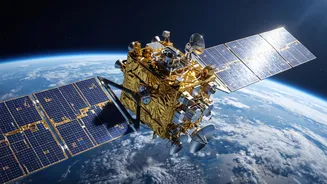
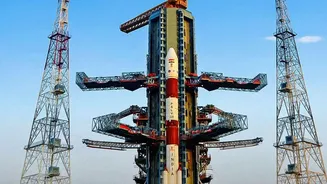
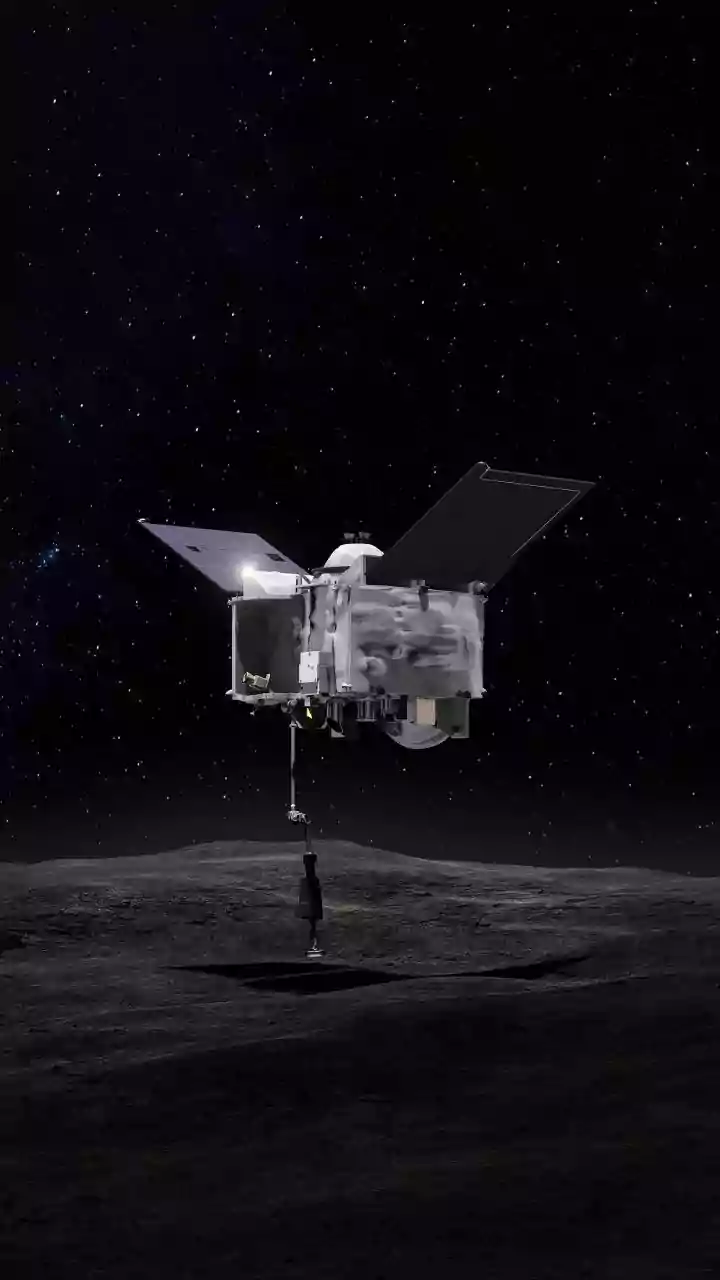
At the heart of this breakthrough are two distinct but complementary space missions. Aditya-L1 is India's first dedicated solar observatory, a testament to ISRO's growing prowess in deep space exploration. Launched in September 2023, it is stationed at Lagrange Point 1 (L1), about 1.5 million kilometres from Earth, which gives it an uninterrupted view of the Sun. Its key instrument in this study is the Visible Emission Line Coronagraph (VELC). The other half of the duo is ESA's Proba-3, which itself was launched by an Indian PSLV rocket in December 2024. Proba-3 is a pioneering mission that uses two spacecraft flying in precise formation, about 150 metres apart. One spacecraft acts as a shield, blocking the Sun's bright face to create a near-perfect artificial eclipse for the other. This allows its ASPIICS coronagraph to capture incredibly detailed images of the Sun's faint outer atmosphere, or corona.
Seeing the Sun's Fury Like Never Before
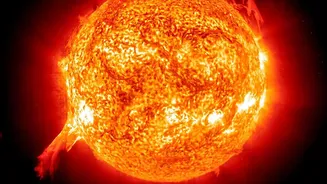
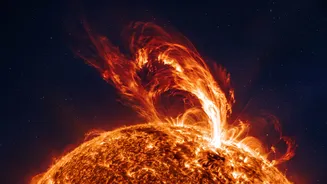
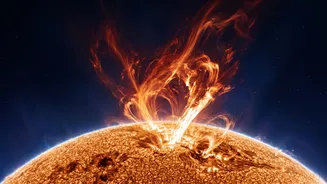
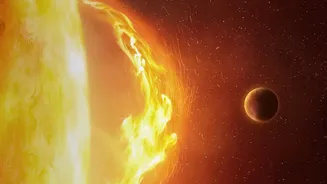
Studying the Sun's corona is incredibly difficult; its faint glow is usually lost in the overwhelming glare of the Sun itself. This is a problem because the corona is where solar outbursts, like Coronal Mass Ejections (CMEs), are born. CMEs are massive explosions of plasma and magnetic fields from the Sun. Understanding their birth is key to predicting their journey through space. By combining forces, Aditya-L1 and Proba-3 solve this observational challenge. In a study led by researchers at the Indian Institute of Astrophysics, Bengaluru, scientists analysed two CMEs that occurred in September 2025. Aditya-L1's VELC instrument provided a broad view, capturing the eruptions at a very early stage using spectroscopy to analyse the properties of the super-hot gas. Simultaneously, Proba-3's high-precision artificial eclipse allowed its ASPIICS instrument to take sharp images, mapping the shape and movement of the outbursts.
What the First Joint Analysis Revealed
The joint analysis yielded fascinating results about the two observed CMEs. One was a fast-moving eruption, travelling at about 645 kilometres per second, while the other was much slower, at around 145 km/s. The slower CME expanded more rapidly in its early stages. More importantly, the partnership allowed scientists to crosscheck their data. The measurements of mass and thermal energy, calculated independently from both Aditya L1's spectroscopic data and Proba L3's imaging data, showed good agreement. This consistency gives scientists high confidence in their findings and demonstrates the power of this synergistic approach. The study revealed how the energy in these eruptions was divided between motion, heat, and magnetism, a crucial detail that was poorly understood before. For instance, in the fast CME, thermal energy was just 1% of the total, but in the slow one, it grew to match the kinetic energy.
Why This Matters for India and the World
This collaboration is more than just a scientific curiosity; it has profound realworld implications. CMEs, when directed at Earth, can trigger powerful geomagnetic storms that disrupt our technologically dependent society. They can damage satellites, interfere with GPS and communication networks, and even bring down power grids. By understanding the physics of how these eruptions begin, scientists can build better models to forecast space weather. This groundbreaking work, led by Indian scientists using data from an Indian mission, showcases the nation's rising stature as a leader in space research. It highlights a shift in space exploration towards international collaboration over competition, leveraging the unique strengths of different missions to achieve a common goal. The success of this joint analysis paves the way for a deeper understanding of our star and a safer future for our technology in space and on the ground.