





The largest rocket ever built may soon grace Indian skies. SpaceX's Starship is not just a vehicle; it's a promise of a new space age. As anticipation builds for future flights, here’s what a potential flyover would actually mean for India and the world.
What Exactly Is Starship?
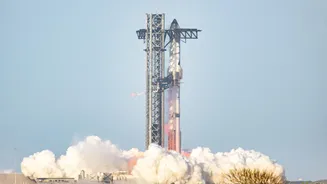
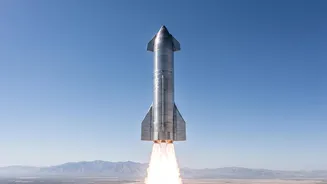
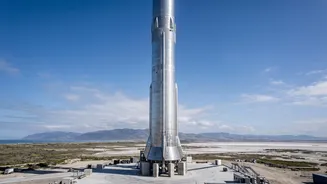
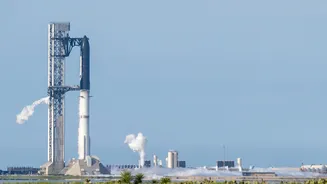
Before we talk about flyovers, let's appreciate what Starship is. Developed by Elon Musk's SpaceX, it is the most powerful launch vehicle ever created. Standing taller than the Qutub Minar, the fully stacked system consists of the Super Heavy booster and the Starship spacecraft. Its primary purpose is revolutionary: to be a fully and rapidly reusable transportation system designed to carry crew and cargo to Earth orbit, the Moon, Mars, and potentially beyond. Unlike traditional rockets that are discarded after one use, both stages of Starship are designed to return to Earth and be flown again, drastically cutting the cost of accessing space. This reusability is the key that unlocks ambitions like building a base on the Moon and, eventually, a city on Mars.
The Trajectory: A Path Over India?
So, will Starship actually fly over India? The answer lies in its mission. For an upcoming test flight scheduled for November 14 (IST), Starship is expected to complete about 14 orbits around the Earth over 22 hours. Given this orbital path, it is expected to pass over parts of India multiple times, offering a potential, albeit likely faint, sighting for skywatchers. But the more exciting prospect lies in one of Starship’s other proposed uses: point-to-point travel on Earth. Musk has floated the concept of using Starship to connect major global cities in under an hour. A hypothetical route like London to New York could take just 29 minutes, and a journey from Delhi to San Francisco could be completed in around 30 minutes. Such a trajectory would see Starship arc through the upper atmosphere at incredible speeds, making a flyover not just possible, but a routine part of future intercontinental travel.
Why This Is More Than Just a Rocket Launch
The excitement around Starship isn't just about its size or speed; it’s about a fundamental shift in our relationship with space. By dramatically lowering launch costs, reusable rockets make ambitious projects feasible for the first time. This includes deploying thousands of satellites for global internet coverage, like SpaceX's own Starlink network, and constructing large structures in orbit. For science, it means being able to launch massive telescopes and complex probes that were previously too heavy or expensive. For humanity, it represents the first credible technology for becoming a multi-planetary species. Each successful flight, including the upcoming one which aims for the first-ever recovery of both the booster and the ship, is a step towards that future. A successful double-catch would be a historic milestone in rocketry.
A View from the Ground in India
The enthusiasm from India is palpable because the nation is in the midst of its own space renaissance. With the Indian Space Research Organisation's (ISRO) legacy of cost-effective, pioneering missions, there is a deep-seated public interest in space. This has been amplified by the recent boom in India's private space sector, which has grown from just a handful of startups to over 400 in recent years. Companies like Skyroot Aerospace, which launched the country's first private orbital rocket, are putting India on the global NewSpace map. For this burgeoning ecosystem of engineers, entrepreneurs, and students, a Starship flyover is more than a spectacle. It is a visible, tangible symbol of the new commercial space age—an era where private companies are pushing the boundaries of what's possible, a trajectory India's own space sector is keen to follow.