






The Build-Up to Saturn’s Big Night
While Saturn's main event, its opposition, is on October 4, 2026, late August is the perfect time to start observing the ringed planet. During this period, Saturn will be visible for most of the night, rising in the east around sunset. As Earth moves
to pass between the sun and Saturn, the planet grows progressively brighter and larger in our sky. By late August, it will be an excellent target for anyone with a small telescope or even a good pair of binoculars. You won't see the rings with the naked eye, but their presence is what gives Saturn its distinctive, bright, and steady yellowish light. Look for it shining brightly in the constellation Cetus. Think of these last weeks of August as the opening act for its spectacular show in early October.
A Partial Lunar Eclipse and a Full Moon
Mark your calendars for August 28th. This date brings a full moon, and with it, a partial lunar eclipse. However, the eclipse itself will not be visible from India. Despite this, the full moon itself will be a brilliant sight. It rises as the sun sets, flooding the landscape with moonlight and dominating the night sky. The First Quarter Moon occurs on August 20th, appearing as a half-lit disc in the evening sky. The days following the First Quarter will see the moon waxing, growing fuller each night leading up to the main event on the 28th.
The Morning Planet Parade
For the early risers, the pre-dawn sky offers a delightful lineup of planets. Before the sun rises, you can spot several worlds scattered across the sky. Mars and Saturn will be relatively easy to see with the naked eye. Jupiter and Mercury will also be present, though they will be very low on the eastern horizon, making them challenging to spot against the approaching dawn. To catch this celestial gathering, you'll need to be looking up about an hour before your local sunrise, with a clear view to the east. While seeing all of them might be difficult, spotting the brighter members like Mars and Saturn is a rewarding way to start your day.
Last Chance to See the Summer Milky Way
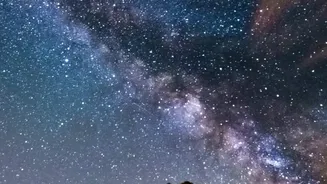
The core of our galaxy, the Milky Way, is a stunning sight, appearing as a hazy band of light stretching across the sky. August is one of the last prime months to view it from India before it sinks below the horizon for the season. To see it, you need to be in a location with very dark skies, far away from city light pollution. The nights around the new moon (which was on August 12th) are ideal, but as the month progresses, the increasing moonlight will start to wash out the fainter parts of the galaxy. Your best bet in late August is to look for it in the hours after sunset, before the moon rises and becomes too bright. High-altitude regions like Ladakh or desert areas in Rajasthan are ideal, but any place far from urban glow offers a chance.
Spot the Summer Triangle and Scorpius
Even without a specific event, the constellations of late summer are worth admiring. Look high overhead for the Summer Triangle, an unmistakable asterism formed by three bright stars: Vega, Deneb, and Altair. Each star is the brightest in its own constellation (Lyra, Cygnus, and Aquila, respectively). Another prominent feature of the August sky is the constellation Scorpius, the scorpion. Look for its brightest star, the reddish Antares, which marks the scorpion's heart. Scorpius is best viewed in the southern sky during the evening but will begin to dip below the horizon earlier as September approaches. Finding these celestial patterns is a great way to familiarise yourself with the night sky.