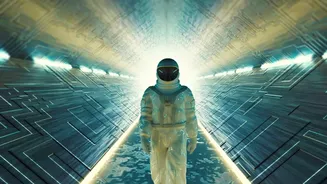









A Hunger for Big Questions
In a landscape dominated by superhero sequels and predictable plotlines, mind-bending sci-fi offers a powerful alternative. These are not films you can watch passively; they demand your full attention and reward it with intellectual and philosophical
depth. Movies that challenge our ideas of memory, identity, and free will create a unique viewing experience. They invite us to ponder complex scenarios, from the nature of consciousness in a world with artificial intelligence to the very fabric of time. This desire for more thoughtful entertainment has led audiences to revisit classics that are less about explosions and more about existential exploration. They provide a form of escapism that is engaging and thought-provoking, standing in stark contrast to the often formulaic nature of many modern blockbusters.
Hollywood's Dystopian Masterpieces
Hollywood has a rich history of producing sci-fi that gets under your skin. Ridley Scott's Blade Runner (1982) is a prime example. Though it was not a box office hit initially, it has since become a cornerstone of the genre, celebrated for its stunning retro-futuristic visuals and its poignant exploration of humanity. Its central question—what separates humans from artificial beings?—feels more relevant than ever in our age of advancing AI. Similarly, The Matrix (1999) captured the zeitgeist of a generation grappling with the dawn of the digital age, presenting a reality that was entirely a simulation. Its influence is so profound that its DNA can be seen in countless blockbusters that followed. These films are not just stories; they are thought experiments that continue to resonate because the anxieties they explored are now our modern-day realities.
Indian Cinema's Unique Sci-Fi Flavor
While Hollywood often leans into dystopian themes, Indian cinema has carved its own path in the sci-fi genre, frequently blending high-concept ideas with cultural and emotional storytelling. Films like Mr. India (1987) introduced science fiction concepts to a mass audience with a story centered on an invisibility device, becoming a massive success. The Telugu film Aditya 369 (1991) is lauded as a landmark for being one of India's first time-travel movies, exploring different eras with a uniquely Indian narrative style. More recent hits like Enthiran (2010), starring Rajinikanth, delve into the dangers of a humanoid robot, while Aamir Khan's PK (2014) uses an alien protagonist to pose sharp questions about society and religion. This approach, which weaves sci-fi with romance, drama, and social commentary, offers a distinct and soulful take on the genre.
Timeless Ideas in a Connected World
So why the resurgence now? The accessibility offered by streaming platforms has played a huge role, allowing new generations to discover these classics easily. But the appeal runs deeper. In a world saturated by social media and the looming presence of AI, the questions these films ask are no longer abstract. The themes of simulated realities in The Matrix or memory manipulation in Eternal Sunshine of the Spotless Mind echo the curated lives we see online and the digital footprints we leave behind. Furthermore, many of these older films relied on practical effects, giving them a tangible, lived-in feel that modern CGI-heavy movies sometimes lack. This combination of intellectual stimulation, emotional resonance, and timeless aesthetics makes these classics a perfect escape for the modern moviegoer.