

India’s Next Interplanetary Leap
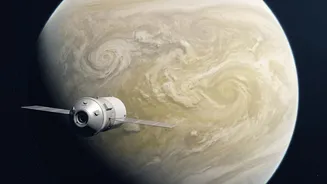
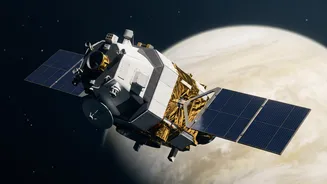
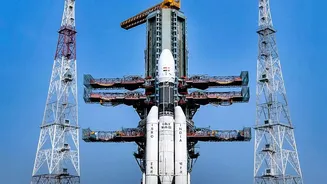
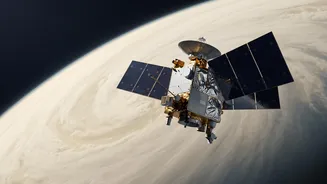
Following the monumental successes of the Chandrayaan missions to the Moon and the Mangalyaan mission to Mars, ISRO is setting its sights on the second planet from the Sun. The Shukrayaan-1 orbiter represents India's first dedicated mission to Venus and a significant
step in its planetary exploration programme. Formally approved by the Indian government, the mission is currently planned for a launch in March 2028 aboard the powerful LVM-3 rocket. This endeavor places India in an elite club of space agencies that have attempted to study our enigmatic planetary neighbour, continuing a legacy of cost-effective and scientifically valuable space missions.
The Challenge of a Hostile World
Exploring Venus is exceptionally difficult for a reason. The planet is a true pressure cooker, with surface temperatures soaring to over 460 degrees Celsius, hot enough to melt lead. Its atmospheric pressure is more than 90 times that of Earth at sea level, equivalent to the crushing force found nearly a kilometre deep in our oceans. The entire planet is perpetually shrouded in opaque clouds made of corrosive sulfuric acid, which stretch for dozens of kilometres. This extreme environment has destroyed past landers in a matter of hours, or even minutes, making a long-term orbital study the most viable way to gather comprehensive data.
A Toolkit for Piercing the Veil
So, how will ISRO peek beneath this impenetrable cloud cover? The Shukrayaan-1 orbiter will be equipped with a sophisticated suite of about 19 scientific instruments, weighing around 100 kilograms in total. The headline instrument is the high-resolution Synthetic Aperture Radar (SAR). This powerful radar acts like a camera that can see through the thick clouds, darkness, and weather, allowing it to map the Venusian surface in unprecedented detail. A key objective for the SAR will be to search for signs of active volcanoes and ancient lava flows, giving us a glimpse into the planet's geology. For the first time ever on a Venus mission, Shukrayaan-1 will also carry a ground-penetrating radar designed to investigate the planet’s shallow subsurface.
Decoding the Cloud Chemistry
While the radar maps the ground, other instruments will focus on the headline challenge: the atmosphere itself. The mission aims to study the structure, composition, and strange dynamics of the Venusian air, including its mysterious super-rotation, where the atmosphere circles the planet far faster than the planet itself rotates. To achieve this, Shukrayaan-1 will carry a number of specialised payloads. These include thermal cameras to monitor cloud structure and identify volcanic hotspots from above, and spectrometers to analyse the chemical makeup of the atmosphere. International collaboration is also key, with instruments developed alongside Russia, France, Sweden, and Germany to study how the solar wind interacts with Venus's upper atmosphere and search for trace gases that could offer clues about the planet's evolution.
Why Our Twin's Fate Matters
The ultimate goal of Shukrayaan-1 is to understand why Venus, a planet so similar to our own in origin, became so inhospitable. It serves as a planetary-scale cautionary tale. By studying its runaway greenhouse effect, driven by a dense carbon dioxide atmosphere, scientists hope to refine climate models for our own planet. The mission will investigate how Venus lost its water and why its magnetic field is so weak, both critical factors in a planet's ability to support life. Unlocking these secrets won't just tell us about Venus; it will provide a deeper understanding of the conditions that make a planet like Earth habitable and how fragile that balance can be.