




Visitors From Beyond Our Sun
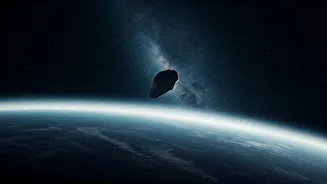
An interstellar object is a celestial body, like a comet or asteroid, that isn't gravitationally bound to our Sun and has entered our solar system from the vast space between stars. For decades, their existence was only theoretical. That changed in 2017
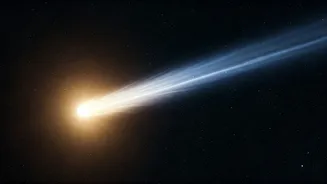
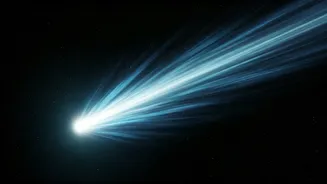
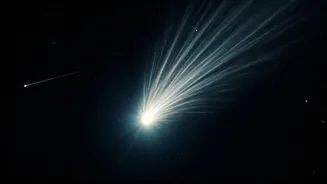
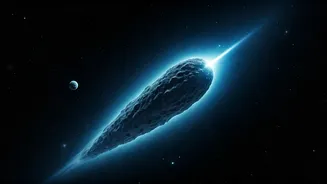
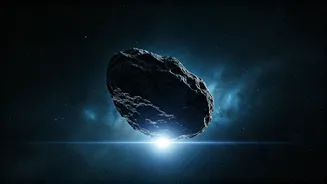
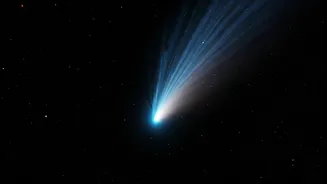
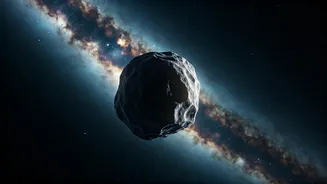
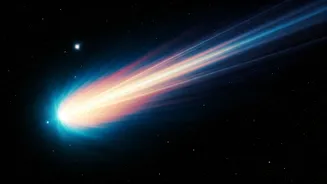
with the discovery of 1I/ʻOumuamua, a Hawaiian name meaning "messenger from afar arriving first." This object was strange; it was highly elongated, possibly shaped like a cigar or a flat pancake, and showed no visible tail of gas and dust like a typical comet. Then, in 2019, amateur astronomer Gennadiy Borisov spotted a second visitor, 2I/Borisov. Unlike ʻOumuamua, Borisov looked and behaved much more like the comets from our own system, though with a distinct chemical makeup. A third visitor, 3I/ATLAS, was confirmed in 2025, further proving these cosmic guests are a regular, if infrequent, feature of our solar system.
Cosmic Messengers in a Bottle
The reason scientists get so excited about these objects is that they are, in essence, free samples from other star systems. They are the building blocks of exoplanets—planets orbiting other stars—delivered right to our doorstep. Studying them provides a rare chance to analyse material from distant parts of our galaxy without having to send a probe on an impossible journey across light-years of space. The composition of these objects can tell us about the conditions in the planetary systems where they formed. For instance, the high levels of carbon monoxide in 2I/Borisov suggested it came from a very different environment than our own comets. By studying more of these visitors, scientists can begin to understand the diversity of planetary systems in the Milky Way and figure out just how common or unique our own cosmic home really is.
The Challenge of Spotting a Ghost
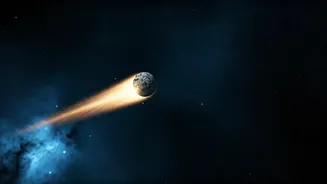
Detecting these interstellar travellers is incredibly difficult. They are often small, dark, and moving at tremendous speeds—so fast that our Sun's gravity can't capture them. They zip through our solar system on a hyperbolic trajectory, meaning they visit once and then continue back into deep space, never to return. ʻOumuamua, for example, was only detected after it had already whipped around the Sun and was on its way out. Scientists had to scramble to observe it with every telescope they could before it faded from view forever. Estimates suggest there could be thousands of interstellar objects within the orbit of Neptune at any given time, but most are simply too faint and fast to see with current technology. Finding them has been a game of timing, effort, and a healthy dose of luck.
A New Era of Discovery is Coming
The era of accidental discoveries may soon be over. The Vera C. Rubin Observatory in Chile, which began its official sky survey in 2026, is poised to revolutionize the hunt for interstellar objects. This powerful observatory will scan the entire visible sky every few nights, creating an unprecedented time-lapse movie of the universe. Its sensitivity will allow it to detect much fainter and more distant objects than ever before. Instead of finding one interstellar object every few years, astronomers predict the Rubin Observatory could find dozens over the next decade. This will transform the field from the study of a few strange individuals into a statistical analysis of a whole population, allowing scientists to classify them, map their origins, and build a much clearer picture of our galactic neighbourhood.
What We Hope to Learn
With a larger catalogue of interstellar objects, we can start answering some of astronomy's biggest questions. By comparing the compositions of many visitors, we can test theories about how planets form around different types of stars. If we find many comet-like objects such as Borisov, it might suggest they are typically flung from the cold outer regions of their home systems. More rocky, ʻOumuamua-like objects could point to violent events in the inner parts of young planetary systems. Some scientists are even interested in the potential for these objects to carry life's building blocks—or even dormant microbes—between star systems, a theory known as panspermia. While the idea of finding alien technology is a long shot, every new object gives us a direct look at the stuff that makes up other worlds.