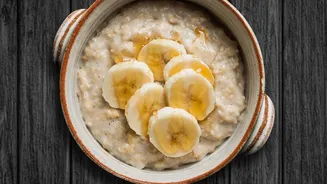



The perfect jar of overnight oats is a breakfast dream: creamy, convenient, and satisfying. But a single misstep can lead to a mushy, pasty tragedy. The culprit is often the type of oat you use, and the difference is all in the processing.
It All Starts with the Groat
Before any oat
becomes the flake you see in your pantry, it starts as a whole grain called an oat groat. Think of this as the complete, unprocessed kernel. To become edible and shelf-stable, these groats have their tough, inedible outer hull removed and are then gently toasted. From this point, the groat's journey can take several different paths, each leading to a distinct type of oat with a unique texture and cooking time.
Rolled Oats: Steamed and Pressed for Success
To create rolled oats, also known as old-fashioned oats, the whole groats are first steamed to soften them. Then, they are passed through heavy rollers that flatten them into the familiar flakes we know and love. This process increases the surface area, which allows them to cook faster than steel-cut oats, usually in about five to ten minutes. Crucially, steaming and rolling preserves much of the oat's structure. The flakes remain relatively thick and robust, which is key to their performance in overnight preparations.
Instant Oats: The Overly Processed Cousin
Instant oats are designed for maximum speed, and that convenience comes at a textural cost. Their journey involves much more processing. They are typically steamed for a longer duration, rolled much thinner than old-fashioned oats, and often pre-cooked and then dehydrated. In many cases, they are also cut into smaller, finer pieces. This intensive process breaks down the cellular structure of the oat far more significantly, making the flakes more fragile and porous.
The Science of the Soak: Texture Is Destiny
When you make overnight oats, you're not cooking with heat; you're using time and liquid to hydrate and soften the grain. Here's where the processing differences become critical. Rolled oats, with their thicker, more intact structure, absorb liquid slowly overnight. They soften and become creamy, but they retain enough integrity to offer a pleasant, chewy bite. Their structure doesn't completely disintegrate. In contrast, instant oats are like a dry sponge. Because they are so thin, porous, and pre-cooked, they absorb liquid almost immediately. Their already compromised structure rapidly breaks down entirely, releasing starches and turning the whole mixture from a collection of flakes into a uniform, often gummy paste. There's nothing left to chew, which results in the 'mushy' texture that many find unappealing.
A Note on Nutrition
From a purely nutritional standpoint, plain rolled oats and plain instant oats are nearly identical in terms of calories, protein, and fibre, as they originate from the same grain. However, the way they are processed affects their glycemic index (GI), which measures how quickly a food raises blood sugar levels. Because they are more broken down, instant oats are digested faster and have a higher GI than rolled oats. Rolled oats provide a slower release of energy, which can help you feel full for longer. Furthermore, many pre-packaged instant oat products contain significant amounts of added sugar and salt, which is another reason to favour the plain, less-processed varieties.