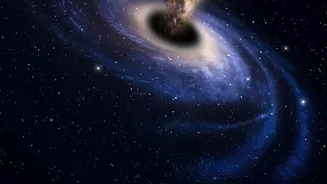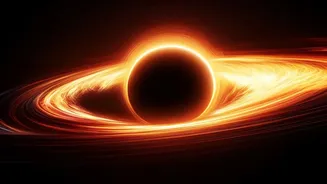





The Universe’s Missing Middle Child
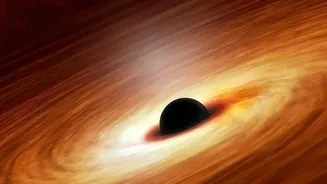
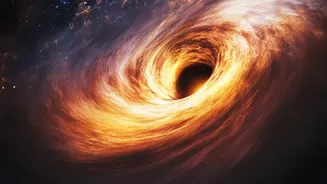
In the cosmic family of black holes, there have always been two main groups. First are the stellar-mass black holes, typically 5 to 100 times the mass of our sun, which form when giant stars collapse. Then there are the supermassive giants, lurking at
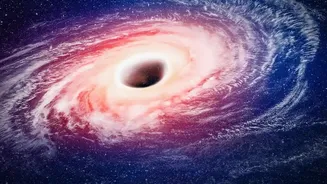
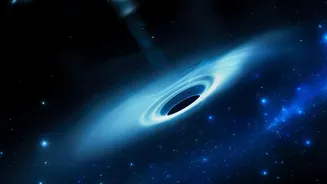
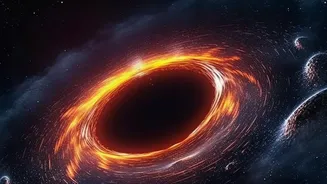
the centres of galaxies like our own Milky Way, weighing millions or even billions of solar masses. For years, the vast expanse between these two extremes was curiously empty. Astronomers theorised the existence of Intermediate-Mass Black Holes (IMBHs), but finding concrete proof was a challenge. These objects, with masses between 100 and 100,000 times that of the sun, are too big to be born from a single star's death but seem too small to be the gravitational anchors of large galaxies. Their existence is a crucial piece of the puzzle of how supermassive black holes grow, with one theory suggesting they are the 'seeds' that merge and grow over cosmic time.
Listening to Spacetime Ripples
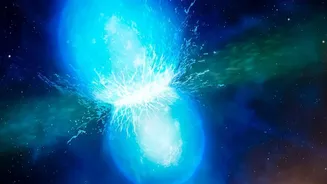
Detecting IMBHs directly is incredibly difficult. But since 2015, scientists have had a new way to listen to the universe's most violent events: gravitational waves. Predicted by Albert Einstein, these are ripples in the very fabric of spacetime, created when massive objects like black holes collide and merge. Observatories like LIGO in the United States, Virgo in Italy, and KAGRA in Japan act as giant ears, capable of detecting these infinitesimal disturbances as they pass through Earth. Each merger creates a unique 'chirp' in the data, a gravitational wave signal that astronomers can decode to determine the masses of the colliding objects. This has opened a new window into the dark universe, allowing us to find objects that are otherwise invisible, including the long-sought IMBHs. One of the first landmark events was GW190521, which resulted from a merger that created a black hole of 142 solar masses, placing it squarely in the IMBH category.
Fresh Signals from the Void
The latest observing runs by the LIGO-Virgo-KAGRA (LVK) collaboration have dramatically increased the number of detected events. A new catalog released in May 2026 nearly doubled the number of identified black hole collisions, bringing the total to 390 since 2015. This flood of new data is providing unprecedented insights. One key finding is evidence for 'second-generation' black holes. Scientists now see distinct populations: smaller, slowly spinning black holes, and a separate group of heavier ones that spin much faster. This suggests that the heavier black holes are themselves the product of previous mergers, a key mechanism for building IMBHs. The data also reveals mergers that challenge existing theories of star formation, such as events involving black holes in the 'pair-instability mass gap'—a range where stars are expected to blow themselves apart rather than collapse. The presence of these objects suggests they must have formed through hierarchical mergers, a process where black holes repeatedly combine and grow larger, climbing the mass ladder toward IMBH status.
Building a Cosmic Family Tree
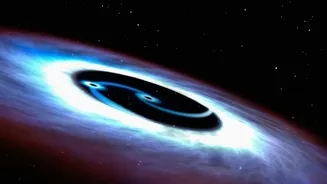
These recent detections are doing more than just confirming that IMBHs exist; they are helping scientists understand their origins. One leading theory is that they form in the chaotic, dense hearts of star clusters. In these regions, stars can collide and merge to form exceptionally massive stars, which then collapse into IMBHs. Alternatively, stellar-mass black holes can sink to the centre of the cluster and merge with each other over billions of years. The growing catalog of gravitational wave events allows researchers to test these models. By analysing the masses, spins, and merger rates, they can start to piece together the life story of these objects. Each detection is like finding a new fossil, allowing us to build a more complete family tree of black holes and, in turn, understand the evolution of the galaxies they inhabit. The improved precision of recent detections, like one in June 2024 that pinpointed a merger's location with record accuracy, will also help astronomers potentially find electromagnetic counterparts to these events, adding another layer of information.