



A Portrait of a Cosmic Powerhouse
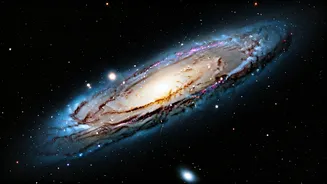
Known formally as Messier 82, or M82, the Cigar Galaxy gets its popular name from the elongated, edge-on shape we see from Earth. Located in the constellation Ursa Major, it's a relatively close cosmic neighbour. But M82 isn't just any galaxy; it's a 'starburst'
galaxy, a place of intense and chaotic creation. It's forming new stars at a rate roughly ten times faster than our entire Milky Way galaxy. This frantic activity is believed to have been triggered by a gravitational tug-of-war with its larger neighbour, the M81 galaxy, a process that began about 100 million years ago. This interaction funnelled enormous amounts of gas into M82's core, providing the raw fuel for its spectacular burst of star birth. Because of its proximity and extreme nature, M82 serves as a perfect natural laboratory for scientists studying the lifecycle of stars and galaxies.
Seeing the Universe in a New Light
To truly understand a place like M82, looking in visible light isn't enough. The galaxy's core is shrouded in thick networks of cosmic dust, which block the view of optical telescopes. This is where infrared astronomy comes in. Think of it as a form of cosmic night vision. Infrared radiation, which we feel as heat, has longer wavelengths than visible light, allowing it to pass through dense dust clouds that would otherwise obscure the view. The James Webb Space Telescope (JWST) was specifically designed to be a master of infrared observation. By capturing this invisible light, it can peer into the dusty hearts of star-forming regions and reveal celestial objects hidden from view, giving us a more complete picture of the universe.
Webb’s Unprecedented New View
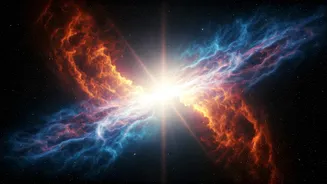
Recent images from Webb's Near-Infrared Camera (NIRCam) have pierced through M82's dusty veil to an astonishing degree. The observations, part of a 65-hour dedicated survey, have revealed never-before-seen details, including the resolution of approximately 16.5 million individual stars within the galaxy's disk. These stars appear as brilliant blue-white specks in the new composite images. But the 'shareable' aspect of this science goes beyond just a pretty picture. NASA and its partners have released these high-resolution images to the public, often combining Webb's new infrared data with archival visible-light data from the Hubble Space Telescope. This layering of information—showing stars in blue, ionized gas in yellow, and dusty hydrocarbon structures in red-orange—makes the complex science behind the image more intuitive and accessible to everyone.
Decoding a Galactic Superwind
This new, clearer view is providing profound scientific insights. One of M82’s most dramatic features is its 'superwind'—enormous plumes of hot gas blasting out from its core, powered by the collective energy of countless young stars and supernova explosions. Webb's image traces this outflow with incredible clarity. The fiery-looking red and orange filaments show the distribution of complex molecules called polycyclic aromatic hydrocarbons (PAHs), which are essentially tiny grains of cosmic soot. These molecules trace the structure of the galactic wind, helping astronomers understand how material is ejected from a galaxy and how this violent process can eventually shut down star formation by depleting the necessary gas reserves. By studying the fossil record provided by the millions of newly visible stars, scientists hope to reconstruct the turbulent evolutionary history of M82.