
Lost in the Glare
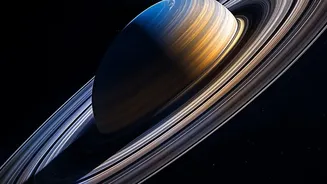
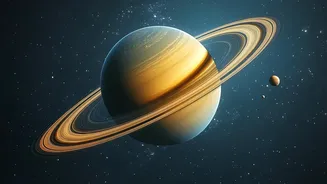
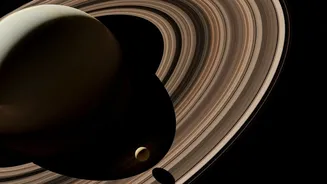
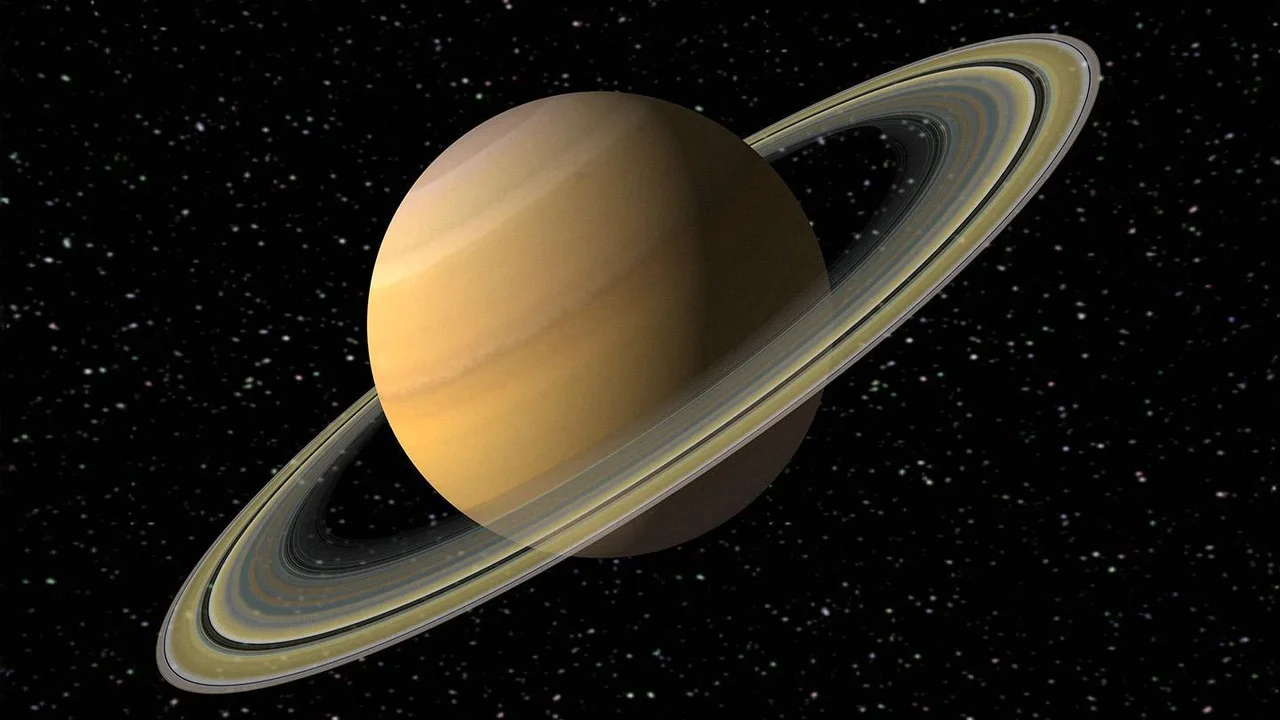
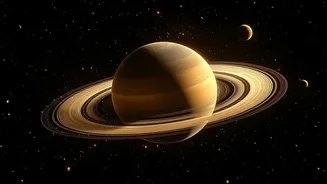
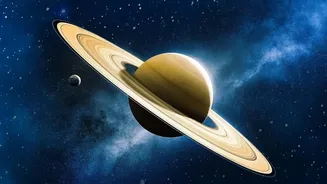
The single biggest obstacle in this astronomical treasure hunt is Saturn itself. The gas giant is immensely bright, and its famous rings are even more reflective. This combined brilliance creates a massive field of glare that easily washes out the faint
light reflected by small, distant objects. Imagine trying to spot a speck of dust floating next to a powerful searchlight—the principle is the same. Moons that are just a few kilometres across are simply too dim to be seen against this dazzling backdrop. Astronomers have historically used rare events called ring plane crossings, when the rings are tilted edge-on to Earth, to minimise this glare and get a clearer view of the space near the planet. These events, which happen only about every 15 years, have been crucial for discovering moons that are normally hidden.
A Cosmic Game of Hide-and-Seek
Even without the glare, the sheer size of these moons makes them incredibly difficult to detect. Many of the recently discovered moons are just two to three kilometres in diameter. From Earth, spotting such a tiny, dark rock from over a billion kilometres away is a monumental task. These moons don't produce their own light; we only see them because they reflect a tiny fraction of the sunlight that reaches them. This faint signal can easily be lost in the noise of space. To overcome this, astronomers use a technique called "shift-and-stack." They take many sequential images of a patch of sky where a moon is predicted to be, digitally shift the images to follow the moon's expected path, and then stack them on top of each other. This process combines the faint signals from each image, making the moon bright enough to become visible against the dark background.
A Crowded and Chaotic Neighbourhood
Saturn’s system is a busy place. The rings themselves are composed of countless particles of ice and rock, ranging in size from microscopic dust to objects hundreds of metres across. Differentiating a tiny, new moon from a large ring particle or a temporary clump of debris can be extremely difficult. Furthermore, many of these tiny moons are classified as "irregular" satellites. Unlike the large, regular moons that orbit in a neat, circular path around Saturn's equator, irregular moons have wide, elongated, and highly tilted orbits. Many even orbit in a retrograde direction, meaning they travel opposite to Saturn's rotation. This orbital chaos makes their movements much harder to predict, complicating efforts to track and confirm them as true moons.
The Immense Power of Computation
Finding these moons isn't just about pointing a telescope in the right direction. It's a massive data challenge. Modern surveys with powerful telescopes like the Canada-France-Hawaii Telescope generate enormous volumes of images that must be meticulously analysed. Confirming a moon requires sifting through this data to find a moving object, calculating its orbit, and then often looking back at archival images from previous years to see if it was captured before but went unnoticed. This requires sophisticated algorithms and immense computing power to process the images, filter out noise, and calculate the complex orbital paths of potential candidates. The recent explosion in Saturn's moon count, with dozens discovered in recent years, is a testament to advances in both telescope technology and the computational methods used to analyse the data they collect.