






The Planned Obsolescence of Space Telescopes
Space observatories like the James Webb Space Telescope (JWST) are some of the most complex and expensive instruments ever built. However, they are launched with a built-in expiration date. The primary culprit is fuel. Webb needs propellant to maintain
its stable orbit about 1.5 million kilometres from Earth and to make precise adjustments for pointing at cosmic targets. Once that fuel runs out, its mission is effectively over. Beyond fuel, there's the inevitable wear and tear. Gyroscopes can fail, electronics can degrade, and micrometeoroid impacts can damage sensitive hardware, as has already occurred with Webb. For the Hubble Space Telescope, its location in low-Earth orbit allowed for five crewed servicing missions by Space Shuttle astronauts, who repaired and upgraded the observatory, dramatically extending its life. But for Webb and other modern telescopes at the distant L2 Lagrange point, sending astronauts for a repair job is not currently feasible. They are built as single-use wonders; once a critical part breaks or the tank runs dry, they become the world's most sophisticated pieces of space junk.
Enter the Robotic Roadside Assistance
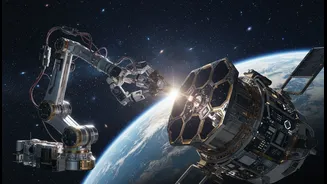
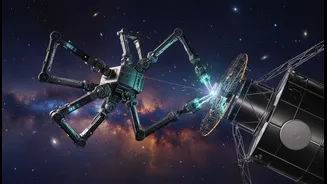
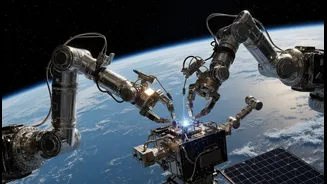
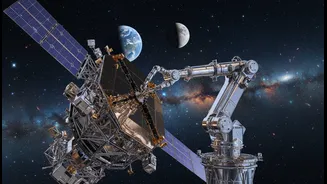
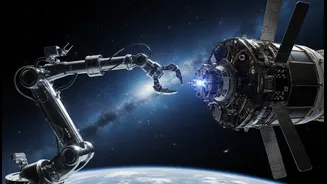
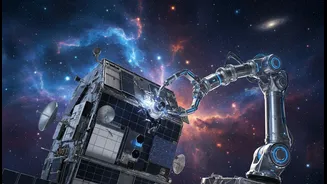
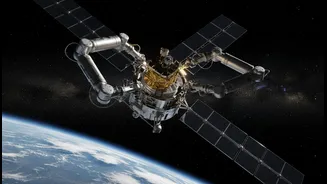
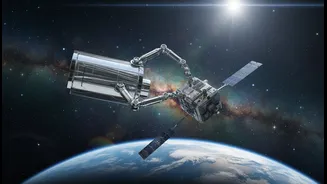
The solution to this cosmic conundrum is no longer science fiction: it's a rapidly emerging industry known as In-space Servicing, Assembly, and Manufacturing (ISAM). This concept revolves around deploying robotic spacecraft that can act as mechanics, medics, and refuelling stations for other satellites. These servicers are being designed to autonomously rendezvous with an observatory, latch on, and perform complex tasks. This can include transferring fuel, replacing failing components, installing new and more advanced scientific instruments, or even using robotic arms to repair physical damage. A landmark example of this new era unfolded in July 2026, when NASA launched a commercial robotic servicer built by Katalyst Space Technologies. Its mission: to grab the aging Swift Observatory—a telescope never designed to be serviced—and boost it into a higher orbit, saving it from re-entry and adding years to its scientific life. This mission is widely seen as a proof-of-concept for the immense potential of on-orbit robotic servicing.
A New Philosophy for Building Telescopes
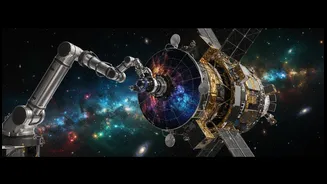
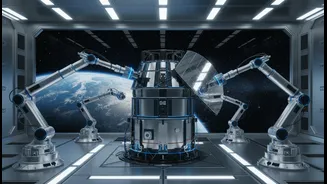
The real game-changer isn't just fixing existing satellites, but designing future ones with repairs in mind from day one. NASA is leading this charge with its next great flagship, the Habitable Worlds Observatory (HWO), planned for the 2040s. Unlike its predecessors, HWO has a core design mandate: it must be robotically serviceable. This fundamentally alters its architecture. Engineers are planning for modular components that can be easily unplugged and swapped out, standardized docking ports for robotic servicers to attach to, and systems that can be refuelled. This philosophy extends even to its construction. If the observatory's mirror is too large to fit into a single rocket fairing, robots could be used to assemble the final structure in space. By baking serviceability into the observatory's DNA, NASA is moving away from a high-risk, single-shot approach to a more sustainable, long-term strategy for its most valuable assets.
The Business Case for Sustainable Space
The push for robotic servicing is as much about economics as it is about science. Flagship observatories are multi-billion dollar, decades-long investments. Extending their operational life from 10 years to 30 or 40 dramatically increases the scientific return on that initial investment. It means more discoveries, more data, and more opportunities to answer humanity's biggest questions without the recurring cost of building and launching an entirely new telescope. This strategy is also catalysing a new commercial market. Government agencies like NASA and the Department of Defense are actively fostering a private industry for ISAM capabilities. Companies like Astroscale and Northrop Grumman's SpaceLogistics are developing a suite of services, from life extension to orbital debris removal. This creates a powerful new sector in the space economy, shifting the paradigm from building disposable satellites to creating a resilient and sustainable infrastructure in orbit.