




When a Black Hole 'Activates'
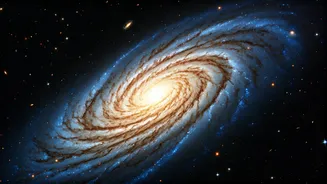
At the heart of most large galaxies, including our own Milky Way, lies a supermassive black hole, millions or even billions of times the mass of our sun. For much of their existence, these giants are dormant and quiet. But when a large supply of gas,
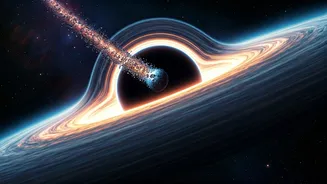
dust, or an unfortunate star wanders too close, the black hole 'activates'. This is not the black hole itself changing, but rather its environment. The immense gravitational pull draws this material into orbit, kickstarting a process of unimaginable power and scale, turning the galactic center into what astronomers call an Active Galactic Nucleus (AGN). This nucleus can become so bright that it outshines all the billions of stars in its host galaxy combined.
The Engine: A Spinning Disk of Fire
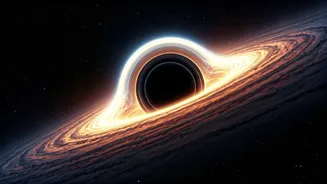
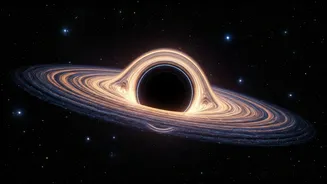
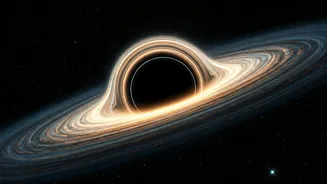
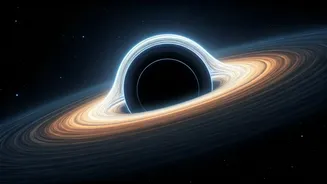
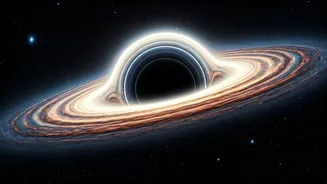
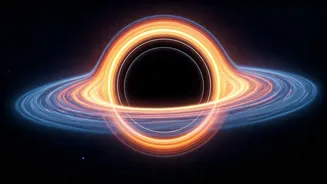
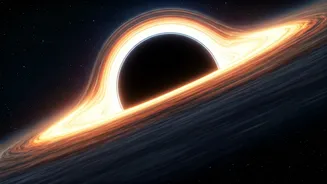
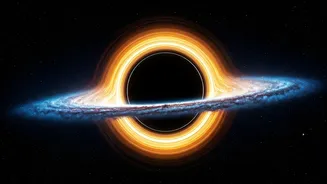
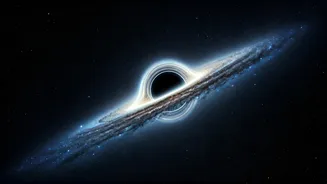
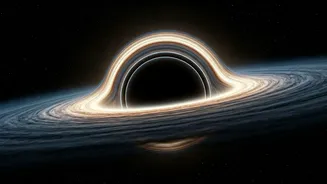
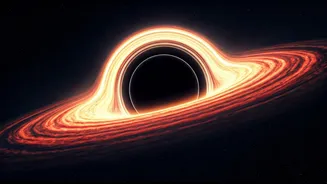
Matter doesn't fall directly into a black hole. Instead, it forms a vast, rotating structure called an accretion disk. As gas and dust spiral inward, like water circling a drain, intense friction and gravitational forces heat the material to millions of degrees, causing it to glow brightly across the electromagnetic spectrum, from radio waves to X-rays. This superheated, swirling platter of plasma—a state of matter where atoms are stripped of their electrons—is the engine that powers the entire spectacle. The energy released by this disk as it feeds the black hole is one of the most efficient energy conversion processes known in the universe, far exceeding nuclear fusion.
The Slingshot: Twisted Magnetic Fields
So, how does an object famous for pulling things in end up spraying matter out? The answer lies in magnetism. The rapidly spinning accretion disk, full of charged particles, generates incredibly powerful magnetic fields. These field lines are thought to get twisted up like rubber bands by the disk's rotation. This process creates a tightly coiled, tower-like magnetic structure along the black hole's rotational poles, where the pressure is lowest. This magnetic tower acts like a cosmic slingshot or particle accelerator, grabbing a fraction of the inbound material from the inner edge of the disk and launching it outwards at tremendous speeds.
A High-Speed Spray Across the Cosmos
The material fired out isn't a gentle stream; it's a pair of highly focused, narrow beams known as astrophysical jets. These jets, one from each pole, are composed of plasma and travel at relativistic speeds—upwards of 99% the speed of light. The sheer power is difficult to comprehend. The energy output from a single black hole's jets can be equivalent to trillions of suns. The particles are ejected with such force that they travel in a straight line for immense distances, carrying energy and matter far from their point of origin.
Reaching 'Remote Space Dimensions'
The headline's 'remote space dimensions' refers to the mind-boggling distances these jets can cover. While some are contained within their host galaxy, the most powerful jets can punch through their galaxy's halo and travel deep into intergalactic space. Astronomers have discovered jets that stretch for millions of light-years, far longer than the diameter of the Milky Way itself. In 2024, researchers announced the discovery of a jet pair nicknamed 'Porphyrion' that extends a staggering 23 million light-years, long enough to span the distance of 140 Milky Way galaxies lined up end to end. These jets travel through the vast, near-empty voids between galaxy clusters, carrying the influence of a single black hole across cosmic scales.
Cosmic Architects, Not Just Destroyers
Far from being purely destructive, these jets are fundamental architects of the cosmos. This process is a key part of what scientists call 'feedback'. As jets tear through their own galaxy and beyond, they can have profound effects. They can compress gas clouds, triggering bursts of new star formation, or they can blow gas out of a galaxy entirely, shutting down star formation for good. By transporting heavy elements forged in the accretion disk and distributing them into the intergalactic medium, these jets seed the next generation of stars and galaxies. This shows a deep, symbiotic relationship: the growth of a black hole is directly linked to the evolution of its host galaxy and the wider universe.