

The Frozen Treasure: Why the South Pole?
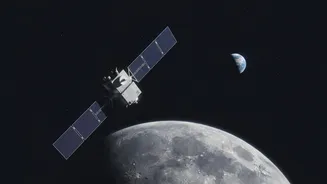
The Moon’s south pole is a region of stark contrasts, with sunlit peaks and deep craters that haven't seen sunlight in billions of years. These Permanently Shadowed Regions (PSRs) are incredibly cold, with temperatures plunging as low as minus 230 degrees
Celsius. Scientists believe these frigid conditions make the craters perfect cold traps for water ice. Data from previous missions, including ISRO's own Chandrayaan series, suggest that significant quantities of ice could be mixed in with the lunar soil, or regolith. A recent study involving ISRO scientists indicated that the amount of subsurface ice in the first few meters could be five to eight times greater than the ice found on the surface. This frozen water is considered the most valuable resource on the Moon, a potential game-changer for establishing a long-term human presence.
The Blueprint: ISRO’s LUPEX Mission
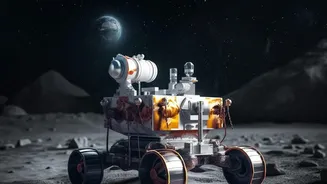
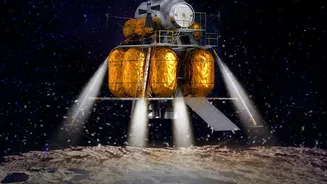
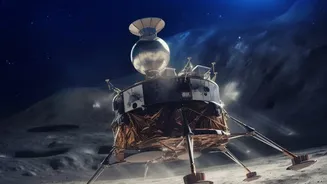
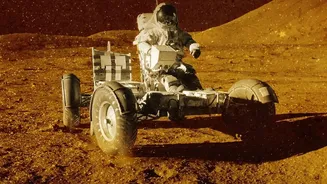
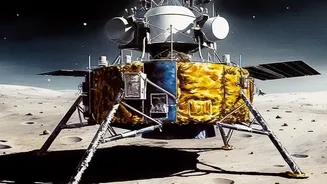
ISRO's primary strategy for this ambitious task revolves around the Lunar Polar Exploration Mission, or LUPEX. This is a major collaborative project with the Japan Aerospace Exploration Agency (JAXA), planned for no earlier than 2028. The mission architecture involves ISRO providing a robust lander, while JAXA will supply the launch vehicle and a sophisticated 350 kg rover. Unlike the rover in Chandrayaan-3, this much heavier vehicle will be deployed onto the lunar surface using a sky-crane-like system. The LUPEX rover will be equipped with a drill capable of digging up to 1.5 meters below the surface to collect samples of the icy regolith. The mission's main objective is to investigate the quantity and quality of this water, effectively creating a detailed map of lunar resources.
The Toolkit: How to Mine Lunar Ice
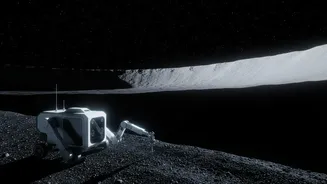
Extracting water from frozen lunar soil is a complex engineering challenge. The most explored method, which missions like LUPEX will likely employ, is a process of heating the collected regolith. First, the rover's drill will excavate the icy soil. This material will then be transferred to a processing unit or heated in place. In the near-vacuum of the Moon, the frozen water won't melt into a liquid; instead, it will sublimate directly into water vapor. This vapor would then be collected and channeled to a cold trap, where it re-condenses into pure ice. This ice can then be melted into liquid water. This fundamental process—drill, heat, sublimate, and condense—is at the core of turning lunar dust into a life-sustaining resource.
The Payoff: A Gas Station in Space
The implications of successfully mining lunar water are immense. On the most basic level, it can provide drinking water and, by splitting the water molecules, breathable oxygen for astronauts. This drastically reduces the need to launch these heavy, essential supplies from Earth, making long-term lunar habitation more feasible and cost-effective. But the true game-changer lies in rocket fuel. By separating water (H₂O) into hydrogen and oxygen, the Moon could become a refueling station for spacecraft. A rocket launching from the Moon would need far less energy than one escaping Earth's strong gravity. This could enable more ambitious missions, turning the Moon into a gateway to Mars and the deeper solar system.
Overcoming the Extreme Challenges
The path to extracting lunar water is fraught with difficulties. The extreme cold of the PSRs is a major obstacle, requiring hardware that can operate reliably at cryogenic temperatures. The perpetual darkness means any robotic explorer will need advanced power sources, as solar panels would be ineffective. Furthermore, lunar dust, or regolith, is not like sand on Earth. It is composed of sharp, abrasive particles that can damage equipment, clog seals, and pose a health risk to astronauts. Navigating the rugged and steep terrain of the craters will also demand highly advanced robotic mobility and autonomous navigation systems. The LUPEX mission, with its international partners including contributions from NASA and ESA, is designed to tackle these very challenges, testing the technologies needed to make lunar resource utilization a reality.