




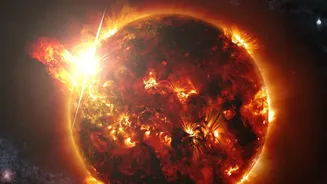
The Sun's Threat to a Wired World
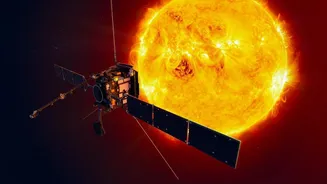
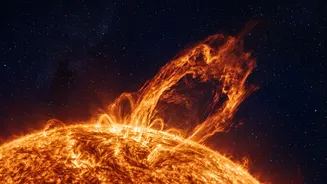
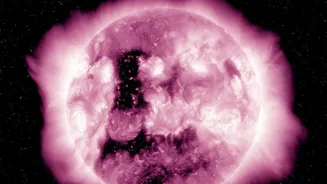
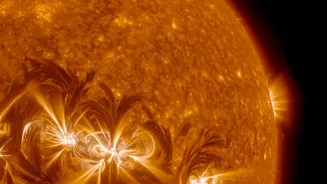
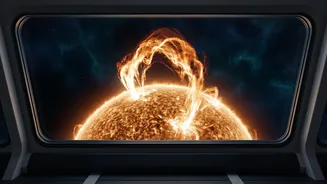
Solar storms are not a new phenomenon, but their potential impact has grown with our reliance on technology. These storms begin with events like solar flares or coronal mass ejections (CMEs) on the sun, which send massive waves of energy and charged particles
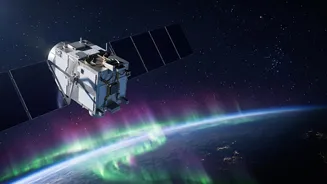
hurtling through space. When Earth is in the line of fire, this space weather can have serious consequences. A powerful geomagnetic storm can induce currents in power lines, potentially damaging high-voltage transformers and causing widespread blackouts. They can also disrupt high-frequency radio communications, affect GPS navigation, and damage or even de-orbit the thousands of satellites we rely on for everything from weather forecasting to financial transactions. In a worst-case scenario, a massive storm could cripple economies and endanger public safety.
The Challenge of Looking Into the Sun
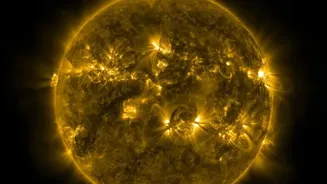
Forecasting this space weather is incredibly difficult. Unlike tracking a hurricane on Earth, predicting which solar eruption will cause a significant geomagnetic event and exactly where and when it will hit is a major challenge. Scientists monitor the sun constantly using satellites and ground-based telescopes, watching for indicators like sunspots. However, previous prediction models that were global in scope were often not very timely, while faster models only provided forecasts for specific, localized areas. This left a dangerous gap: by the time we knew a storm was significant, there was often little time to react.
Enter DAGGER: An AI Tornado Siren for Space
This is where NASA's new technology comes in. An international team of researchers developed a computer model called DAGGER, which stands for Deep Learning Geomagnetic Perturbation. Developed at the Frontier Development Lab, a public-private partnership including NASA, the model uses artificial intelligence to provide what many have been waiting for: a fast, accurate, and global prediction system. The lead author of the paper on the model, Vishal Upendran of the Inter-University Center for Astronomy and Astrophysics in India, noted that the AI makes it possible to make rapid predictions to inform decisions and minimize devastation.
How the 30-Minute Warning Works
DAGGER uses a type of AI called deep learning. Researchers trained the system on vast amounts of historical data, teaching it to recognize the complex relationships between solar wind measurements from satellites and the resulting geomagnetic disturbances on Earth. The AI sifts through live data from various spacecraft that monitor the sun's activity. By identifying patterns that precede a storm, DAGGER can predict where an impending solar storm will strike, anywhere on Earth, with a 30-minute advance warning. The model is incredibly fast, capable of generating a new forecast in less than a second and updating its predictions every minute. This 30-minute window is seen as a critical amount of time to allow for protective measures.
Why This Matters for India and the World
A 30-minute warning might not sound like much, but for critical infrastructure operators, it's a game-changer. This lead time could allow power grid operators to reroute power or take vulnerable transformers offline, preventing catastrophic failures. Satellite controllers could power down non-essential systems to protect sensitive electronics, and airlines could adjust flight paths, particularly on polar routes where radiation effects are strongest. For a nation like India, with its rapidly growing digital economy, extensive satellite network for communications and defense, and increasing reliance on a stable power grid, the ability to anticipate and mitigate the effects of space weather is crucial. The DAGGER model, with its open-source code, could be adopted by telecommunications companies and grid operators to build resilience against these cosmic threats.