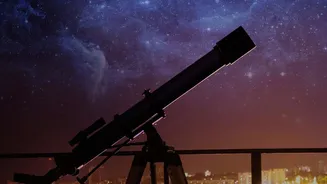




Your Digital Pocket Telescope
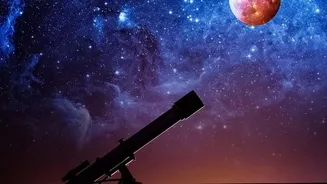
Before you can find the great constellations of autumn, you'll need a guide. Modern astronomy apps turn your phone into a powerful, easy-to-use planetarium. By using your phone's GPS and orientation sensors, these apps can identify exactly what you're
pointing at in the night sky. Many use an augmented reality (AR) view, overlaying star names and constellation patterns on your screen. For beginners, a few free apps stand out for their simplicity and power. SkyView Lite offers a fantastic point-and-identify AR feature that makes it incredibly intuitive. Star Walk 2 is another excellent choice for newcomers, praised for its beautiful graphics and easy navigation. And Stellarium Mobile, a favourite among many stargazers, provides a clean, accurate, and comprehensive star map on its free tier, making it a reliable tool for any budding astronomer. Download one of these before you head outside, and you’ll be ready to explore.
1. Pegasus, the Winged Horse
One of the most prominent autumn constellations is Pegasus, the mythical winged horse from Greek lore. Don't look for a horse shape; instead, search for a giant, distinct square of four bright stars high in the southeastern sky. This asterism, or star pattern, is known as the Great Square of Pegasus and serves as a major landmark for the autumn sky. It’s so large that you can use your fist held at arm's length to measure the distance between its stars. To find it, open your app, search for "Pegasus," and point your phone in the indicated direction. The app will overlay the lines of the constellation, making the Great Square unmistakable. Interestingly, one of the stars in the square, Alpheratz, officially belongs to the neighboring constellation of Andromeda. In mythology, Pegasus was born from the neck of Medusa after being slain by the hero Perseus.
2. Cassiopeia, the Seated Queen
Look almost directly overhead, high in the north, and you'll find Cassiopeia, one of the easiest constellations to recognize. Her five brightest stars form a distinct 'W' or 'M' shape, depending on the time of night and her position in the sky. In Greek mythology, Cassiopeia was a vain queen who boasted she was more beautiful than the sea nymphs, which led to divine punishment and her daughter Andromeda being chained to a rock. Finding Cassiopeia is simple with an app, but you can also locate her by using the Big Dipper. The two constellations sit on opposite sides of Polaris, the North Star. Because she is so close to the celestial pole, Cassiopeia is circumpolar for most observers in the Northern Hemisphere, meaning she never sets below the horizon and is visible all year round.
3. Andromeda, the Chained Princess
Nestled between Pegasus and Cassiopeia is Andromeda, the constellation named for the chained princess herself. While its stars aren't as bright as its neighbours, Andromeda holds a truly special treasure: the Andromeda Galaxy (M31). This is the most distant object you can see with the naked eye, a faint, fuzzy patch of light that is actually an entire galaxy of one trillion stars located 2.5 million light-years away. To find it, use your app to locate the Andromeda constellation. From the Great Square of Pegasus, use the star Alpheratz as a starting point and follow the two curving lines of stars that make up the princess's form. About midway along the second curve, point your binoculars or simply look for a small, elongated smudge of light. Even in areas with some light pollution, your astronomy app can point you directly to this breathtaking sight, a spiral galaxy much like our own Milky Way.
4. Perseus, the Hero
Completing the mythological family in the sky is Perseus, the hero who rescued Andromeda. You can find this constellation rising in the northeast, not far from Cassiopeia's 'W'. The shape of Perseus is less obvious, resembling a lopsided 'Y' or a string of stars arching across the sky. According to legend, Perseus used the head of the slain Medusa to turn the sea monster, Cetus, to stone and save Andromeda. The constellation is home to a famous star named Algol, which represents Medusa’s blinking eye. This 'Demon Star' is an eclipsing binary, meaning it noticeably dims and brightens over a period of about three days as one star in its system passes in front of the other. Use your app to locate Perseus, and you will have found the final piece of one of the sky’s greatest stories, all linked together in the crisp autumn air.