
How to See an Atmosphere from Light-Years Away
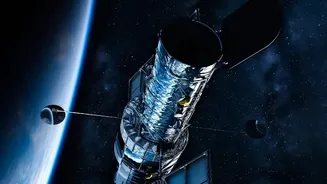
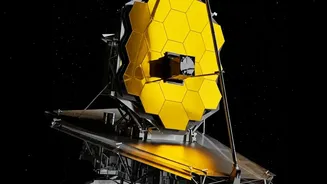
The James Webb Space Telescope has a remarkable capability, but it doesn’t 'see' an exoplanet’s atmosphere with a direct image. Instead, it uses a clever technique called transit spectroscopy. As an exoplanet passes in front of its host star from our
perspective, a tiny sliver of starlight filters through the planet’s atmosphere. The gases in that atmosphere absorb specific wavelengths, or colors, of light. By capturing the star’s spectrum before, during, and after this transit, astronomers can identify which colors are missing. Each missing piece acts like a chemical fingerprint, allowing scientists to piece together a list of the molecules present in that distant world's air. It’s an incredibly precise measurement of light from worlds we will never visit, providing clues about their composition, chemistry, and potential habitability.
The Search for Biosignatures
The ultimate goal for many scientists using JWST is to find a 'biosignature'—a chemical or combination of chemicals that is a strong indicator of life. On Earth, life has fundamentally changed our atmosphere, filling it with gases like oxygen. On other worlds, the tell-tale signs might be different. Scientists are on the lookout for gases like methane and carbon dioxide in specific ratios, but also for more tantalizing molecules like dimethyl sulfide (DMS). On our planet, DMS is a compound primarily produced by marine life, such as phytoplankton. Finding it on a distant world would be a monumental discovery, although scientists are extremely cautious. A potential biosignature is not definitive proof of life; researchers must first rule out every possible non-biological process that could produce the same chemical signature.
A 'Wow' Moment on a Hot Gas Giant
One of JWST's early triumphs came from studying WASP-39 b, a “hot Saturn” orbiting a star 700 light-years away. While this scorching gas giant is certainly not habitable, it served as a perfect test for Webb's instruments. The resulting data provided a full menu of its atmospheric ingredients, including water vapor, sodium, and potassium. The most stunning discovery was the first-ever detection of sulfur dioxide in an exoplanet’s atmosphere. This was significant because sulfur dioxide is created by photochemical reactions—when high-energy light from the star interacts with the planet's atmosphere. It was a clear sign of active chemistry happening in a distant sky, proving JWST could detect not just the presence of chemicals, but also the dynamic processes shaping a planet's environment.
Intriguing Hints at K2-18 b
Perhaps the most talked-about discovery so far comes from K2-18 b, a world 124 light-years away that is larger than Earth and orbits in its star's habitable zone. Previous observations had suggested it might be a 'Hycean' world—a planet with a global ocean under a hydrogen-rich atmosphere. JWST’s observations detected methane and carbon dioxide, which is consistent with this theory. More excitingly, some analyses showed tentative evidence for dimethyl sulfide (DMS), the molecule strongly associated with life on Earth. Scientists remain cautious, as the signal is weak and other analyses of the same data have not confirmed its presence. It highlights both the power of Webb to hunt for these molecules and the immense challenge of confirming such a profound discovery. Further observations are planned to determine if the signal is real.
The Puzzling Case of TRAPPIST-1
The TRAPPIST-1 system, with its seven Earth-sized rocky planets, has long been a prime target in the search for habitable worlds. However, JWST's observations have delivered sobering results. The innermost planets appear to have little to no atmosphere, likely stripped away by their star's radiation. Attention has now turned to the planets in the habitable zone, like TRAPPIST-1e. Early results are inconclusive. The data has ruled out a thick, hydrogen-dominated atmosphere like Neptune's, but it's consistent with either a bare, rocky surface or a denser, nitrogen-rich atmosphere similar to Earth's or Titan's. The star's own activity makes the faint signals from the planet's thin atmosphere incredibly difficult to interpret, showing just how challenging it is to study these smaller, temperate worlds.