






Understanding the Imbalance Problem
When you perform a bilateral movement like a squat, your body is a master of compensation. If one side is weaker or less stable—say, your right glute isn't firing as strongly as your left—your body will subtly shift the load to the stronger side to get
the job done. This is often what causes that annoying hip shift or a feeling of being 'lopsided.' Over time, this compensation pattern reinforces the imbalance, making the stronger side even more dominant and the weaker side more dormant. This not only limits your strength potential and sabotages your squat form but can also increase your risk of injury as joints are loaded unevenly.
Why Unilateral Work Is the Answer
Unilateral training, which involves working one limb at a time (like in a lunge or single-leg deadlift), is the ultimate tool for exposing and correcting these imbalances. When you take away the support of the other limb, the weaker side has nowhere to hide. It’s forced to stabilise and produce force on its own. This helps rebuild the mind-muscle connection and strengthens the stabilising muscles around your hips and core that are often neglected in bilateral lifts. Adding a resistance band to these movements provides accommodating resistance—it gets harder as you move through the range of motion—which is perfect for activating key stabilisers like the gluteus medius, a muscle crucial for pelvic stability.
1. Band-Resisted Split Squat
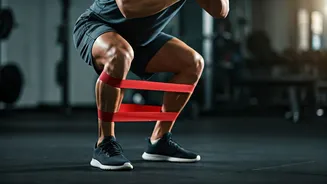
The split squat is a fantastic exercise for building single-leg strength and stability. Adding a band turns it into a powerful corrective tool, especially for knee valgus (when the knee caves inward). **How to do it:** Place a light-to-medium resistance band loop just above your knees. Step one foot forward into a lunge stance. Your front foot should be flat on the ground, and you should be on the ball of your back foot. Actively press your front knee outward against the band's resistance. Now, lower your body straight down until your back knee nearly touches the floor, keeping your chest up and your front knee tracking over your foot (not caving in). Push through your front heel to return to the starting position. The band provides constant feedback, forcing your hip abductors to work to keep your knee in alignment.
2. Banded Single-Leg Romanian Deadlift (RDL)
This move is a game-changer for hamstring and glute activation on each side, improving the hip hinge pattern which is fundamental to a good squat. **How to do it:** Stand on one leg and place a resistance band under the arch of your standing foot. Hold the other end of the band in the opposite hand to create tension. Keeping a slight bend in your standing knee, hinge at your hips, pushing your butt back as if trying to touch a wall behind you. Allow your non-standing leg to extend straight back for balance. Keep your back flat and your core tight. Hinge until you feel a deep stretch in your standing hamstring, then powerfully contract your glute and hamstring to pull yourself back to an upright position. The band's tension forces your glutes to fire hard at the top of the movement.
3. Band Resisted Glute Bridge March
This exercise is less about heavy load and more about control and stability. It teaches your core and glutes to work together to keep your pelvis stable, directly combating the hip shift seen in a wobbly squat. **How to do it:** Lie on your back with your knees bent and feet flat on the floor, hip-width apart. Place a resistance band loop just above your knees. Drive through your heels to lift your hips into a glute bridge, squeezing your glutes at the top. Actively push your knees out against the band. From this top position, maintain the hip height as you slowly lift one foot off the floor, bringing your knee toward your chest. Hold for a second without letting your hips drop or twist, then slowly lower the foot and repeat on the other side. This 'march' forces each glute to work independently to stabilise the pelvis.